A content delivery network (CDN) distributes servers across many locations and delivers content from an edge node near the user. This reduces latency by shortening the physical distance to content and computation. section 9.2.3
CDNs support progressively richer delivery patterns:
- Cache static assets such as HTML, images, and scripts at locations worldwide. section 9.2.3
- Receive requests at edge nodes and perform lightweight processing, such as blocking bots or malicious traffic. section 9.2.3
- Run application logic at the edge, bringing dynamic features closer to users instead of sending every request to centralized infrastructure. section 9.2.3
A blog with comments
A static blog can serve readers in Tokyo from a nearby Tokyo edge location rather than an origin server in Virginia. A comment system can also run near the reader, fetching, ordering, nesting, and filtering comments without routing every request to a centralized database. section 9.2.3
Figure 9.4 Request flow with edge compute. Incoming requests first hit the edge node, where user-defined Wasm code can perform logic before routing to the centralized cloud backend.
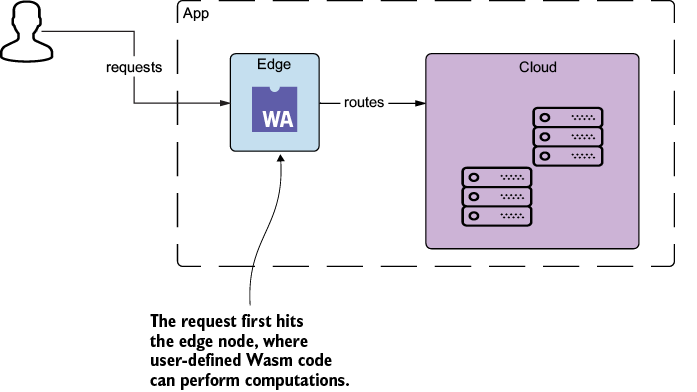
Trace how a request reaches an edge node, where user-defined Wasm code can process it before routing to a centralized cloud backend. section 9.2.3



