liveBook · Manning

Text chunk

As explained in Building Reliable AI Systems

A segment of text produced by dividing a larger document for processing or retrieval.

A text chunk is a manageable segment of a larger document, created by splitting loaded data into paragraphs, sections, or other retrieval units. Chunks are embedded and stored as part of indexing, helping prepare information for precise retrieval. section 3.4

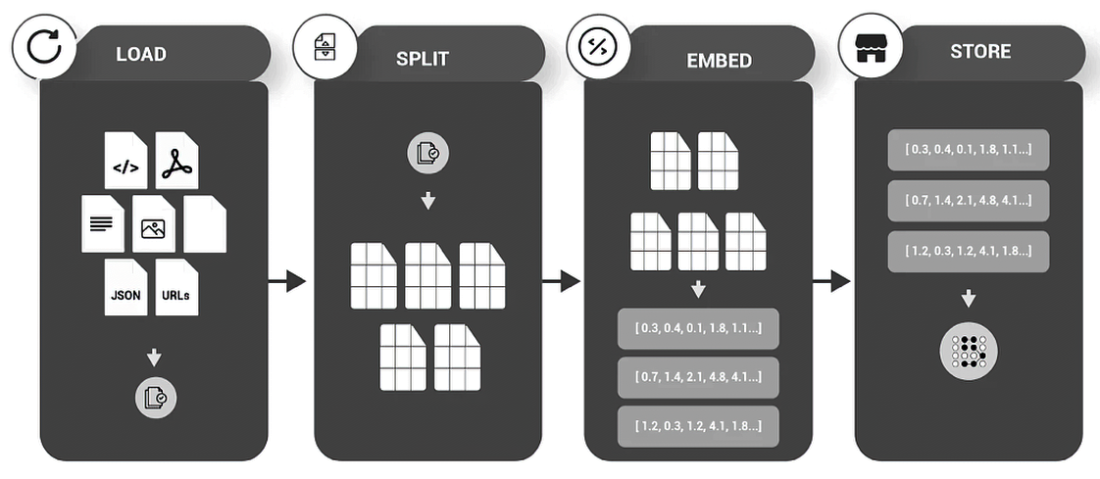
Figure 3.3 The indexing process consists of four steps: loading the data, splitting or segmenting the data, embedding or converting the data to vectors, and storing the embeddings in a structured repository.
figure

See where splitting fits in the indexing flow: after loading data and before embedding and storing it. section 3.4


How Building Reliable AI Systems covers it

How deep it goes
Describes splitting loaded data into manageable chunks, including paragraphs or sections, without detailing splitter configuration.
Examples
Uses paragraphs or sections as chunk boundaries when dividing loaded documents.
What you can do after
Apply text splitters to segment loaded documents into manageable units for embedding and retrieval.
How it connects
Connects text chunks to text splitters, embeddings, and retrieval in RAG indexing.

Also explained in

Compare how 19 books explain text chunk →

Related concepts

This explainer was generated by Manning's knowledge graph from the text of Building Reliable AI Systems. The section links point to the parts of the book it draws on.
















