A text chunk is a smaller contiguous segment of source text created for processing or retrieval. Chunking can turn a long policy into sentences, paragraphs, or other fine-grained knowledge strips, reducing irrelevant context before generation. section 11.2.2
Text chunks support two complementary retrieval patterns:
- In Decompose-then-Recompose, an evaluator re-scores each chunk against the query, discards irrelevant segments, and concatenates the useful remainder into a dense context. section 11.2.2
- In Clue-RAG, chunks are raw-data nodes connected with knowledge units and entities; they can bridge missing entity-to-entity links during graph traversal. section 12.6.2
Transaction-limit lookup
A 20-page AML policy may contain one relevant paragraph or table row. Chunking lets the system retain that precise evidence while dropping surrounding definitions and boilerplate, improving the signal-to-noise ratio presented to the generator. section 11.2.2
Figure 11.4 The Decompose-then-Recompose Algorithm: Distilling signal from noise in retrieved documents.
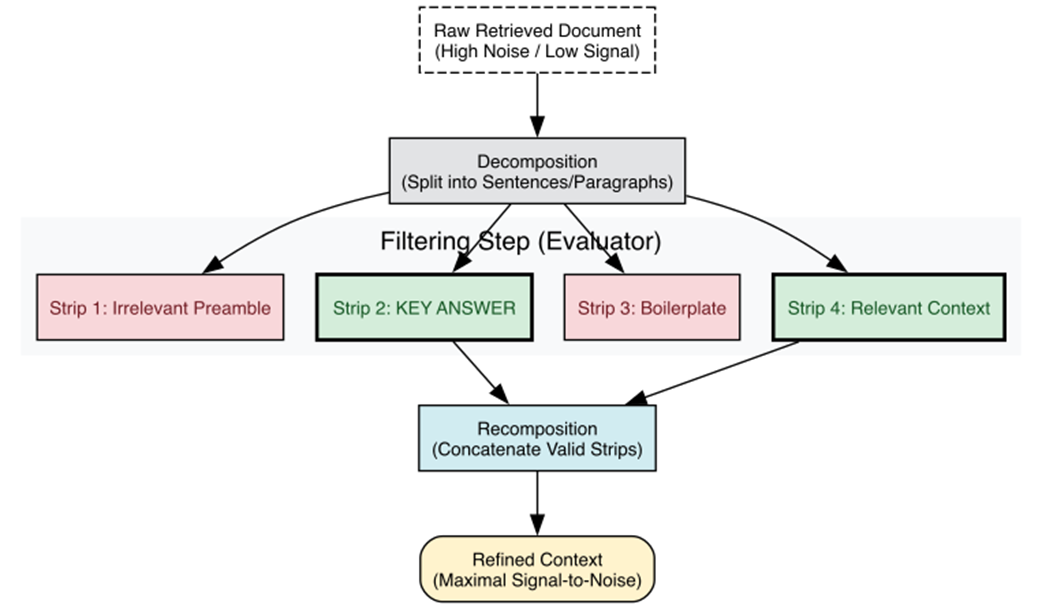
Follow the decomposition, filtering, and recomposition flow from a retrieved document to a refined context. section 11.2.2























