A cloud-native network function (CNF) is a cloud-native application that implements telecommunications network functionality. It consists of one or more microservices developed with principles such as immutable infrastructure, declarative APIs, and repeatable deployment. CNFs extend the move from physical appliances to virtualized network functions (VNFs) toward containerized workloads, with the aim of improving portability, agility, manageability, and efficiency. section 8.1.3 section 8.0
The transition is relevant to 5G network functions and the radio access network. Virtualizing mobile base stations was considered for network functions virtualization (NFV) but did not effectively materialize there; containerized workloads and new 5G radio functions are pushing these functions toward CNFs. section 8.1.2
On Anthos on bare metal, a CNF that needs separate network paths can use multiple interfaces per Pod:
- Enable multipleNetworkInterfaces in the clusterNetwork portion of the bare-metal cluster configuration. section 8.3.2
- Define additional networks with NetworkAttachmentDefinition resources, then assign them through Pod or deployment annotations. The default Kubernetes interface appears as eth0; additional interfaces appear as net1, net2, and so on by default. section 8.3.2
- Choose an additional-interface CNI appropriate to the deployment: IPvlan, MacVLAN, Bridge, or SR-IOV. Separate data-plane traffic from management or control traffic when performance, security, or flow isolation requires it. section 8.3.2
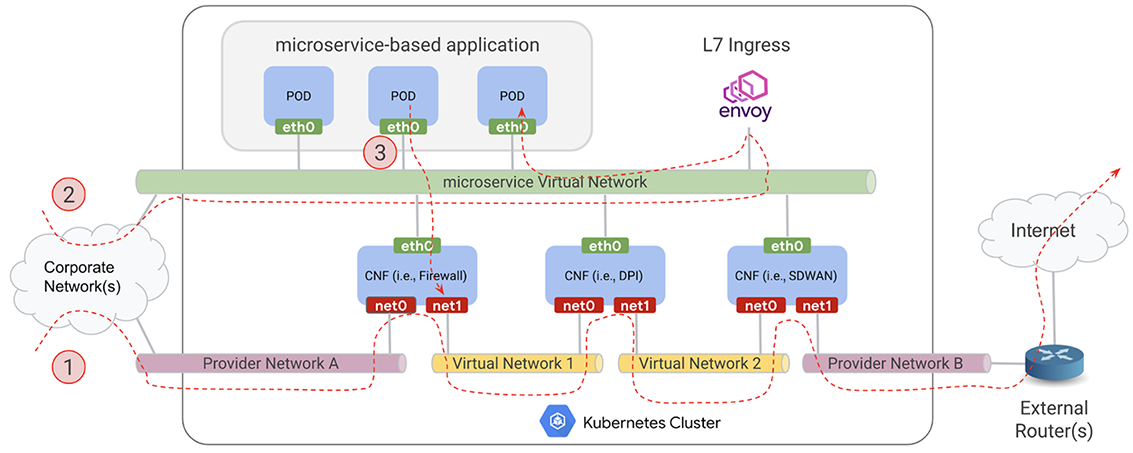
The diagram shows a CNF using multiple NICs to connect to different network segments, making the traffic-separation requirement concrete. section 8.3.2
Deployment location and management model remain choices, not properties of the CNF itself. Google Distributed Cloud Edge supports virtualized and cloud-native network functions on Anthos on bare metal at public-cloud, telco, or enterprise edge sites. Its managed infrastructure and fleet capabilities can support distributed deployments; Anthos capabilities include multiple Pod interfaces, hardware accelerators, and large-fleet management. section 8.3.1 section 8.4
