A virtual network function (VNF) implements a telecommunications network function as software inside a virtual machine on virtualized, industry-standard infrastructure. NFV separates the design into VNFs, network function virtualized infrastructure (NFVI), and management and orchestration (MANO): workloads, hosting hardware and virtualization software, and lifecycle management. section 8.1.1
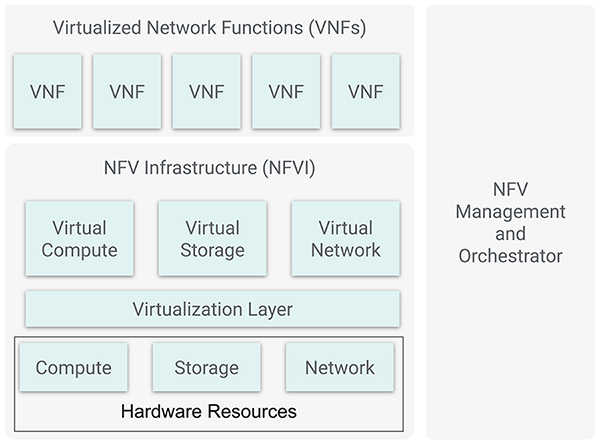
Use the high-level NFV architecture to distinguish the virtualized function from its infrastructure and lifecycle-management domains. section 8.1.1
Common VNF deployments move established network appliances into provider-controlled infrastructure:
- vCPE virtualizes customer-premises routing and network functions, allowing simpler hardware at homes or enterprise sites. section 8.1.2
- vPE virtualizes provider-edge routers, while vEPC virtualizes mobile-core functions such as mobility management, serving gateway, and packet data network gateway. section 8.1.2
- vCDN virtualizes content-delivery appliances; vRAN was considered for radio access networks but increasingly points toward containerized network functions (CNFs). section 8.1.2
VNFs remain relevant alongside CNFs during the transition toward Kubernetes and Anthos. Anthos on bare metal supports VM-based workloads through Anthos VM Runtime, based on KubeVirt. High-performance deployments can use SR-IOV for direct virtual-function access to network hardware and DPDK for accelerated networking. Multiple network interfaces support workloads that connect separate network segments. section 8.3.2 section 8.4
Running a VNF-oriented VM on Anthos
Enable the VMRuntime custom resource, choose hardware virtualization or emulation, and create a VM with specified image, CPU, memory, disk, storage class, and cloud-init settings. Anthos VM Runtime then provides the VM deployment path within the bare-metal cluster. section 8.3.2
