Google Distributed Cloud Edge (GDCE) is a fully managed edge platform for telco virtualized and cloud-native network functions and edge applications. It combines Google-provided hardware, operating systems, and software in Google-managed racks at customer locations. section 8.3.1 section 8.4
GDCE decomposes the deployment into several managed and customer-facing responsibilities:
- Supports public cloud edge locations, telco-owned sites, and enterprise sites such as retail stores, factory floors, branch offices, and stadiums. section 8.3.1
- Provides compute, storage, servers, and top-of-rack network switches, while Google ships, remotely monitors, and manages the underlying gear. section 8.3.1
- Uses Anthos on bare metal to support containerized workloads and virtual machines, with fleet management for hardware and software assets. section 8.3.1 section 8.4
- Organizes Kubernetes worker servers into node pools, while hosting the control plane on Google Cloud in a single compute region. section 8.3.1
- Connects users to Google Cloud through VPN access to customer VPC applications and other Google Cloud services. section 8.3.1
- Accelerates high-performance, low-latency workloads with technologies such as SR-IOV and DPDK. section 8.3.1
Enterprise edge site
A retailer, factory, branch office, or stadium can host Google-managed GDCE racks locally, run containerized applications or virtual machines, and connect those workloads to services in its VPC through VPN. section 8.3.1
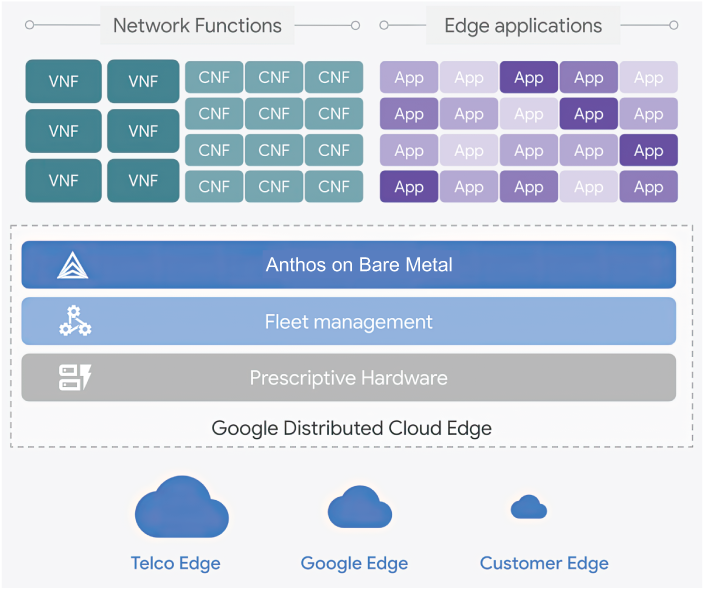
Use the high-level architecture to relate Google-managed racks, the edge Kubernetes environment, and Google Cloud connectivity. section 8.3.1
