A cloud provider operates infrastructure and delivers computing resources or complete platforms and applications as subscription services. Customers gain access without owning or maintaining the underlying resources. section 17.3.2
Cloud providers commonly deliver three service models:
- Software as a Service (SaaS) delivers provider-hosted applications over a network, such as Microsoft 365, Google Workspace, Slack, Dropbox, and Zoom. section 17.3.2
- Platform as a Service (PaaS) supplies a managed platform for developing, running, and managing applications without building the supporting infrastructure. section 17.3.2
- Infrastructure as a Service (IaaS) supplies computing resources, storage, and networking on demand; customers can create virtual machines and install operating systems. section 17.4
Cloud services typically provide on-demand self-service, broad network access, resource pooling, rapid elasticity, and measured service. Public-cloud infrastructure is available to the public from provider premises. section 17.4
Figure 17.14 The spectrum of what is offered in each cloud service model in comparison to colocation and on-prem solutions
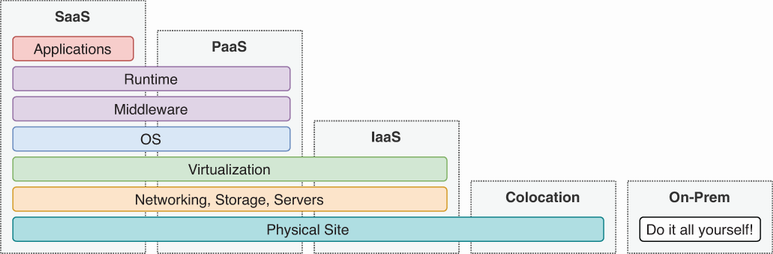
Compare the responsibility and resource spectrum across on-premises, colocation, IaaS, PaaS, and SaaS arrangements. section 17.3.2



