liveBook · Manning

Cloud provider

As explained in Platform Engineering on Kubernetes

A cloud provider is a service provider that supplies on-demand computing, storage, networking, and related infrastructure resources.

A cloud provider supplies services across layers, from on-demand computing hardware to managed databases and application-level capabilities. Higher-level services bundle more operational responsibility and therefore usually cost more. section 1.1.1

Work with a cloud provider through several developer-facing surfaces:

  • Use APIs to create resources, configure parameters, choose regions, and define service contracts. section 1.1.3
  • Use SDKs to call provider services from application code, while accounting for language, framework, and dependency coupling. section 1.1.3
  • Combine dashboards, CLIs, APIs, and SDKs to provision resources, deliver changes, monitor usage, inspect costs, and handle incidents. section 1.1.5

Managed PostgreSQL

Provisioning a highly available PostgreSQL database through a managed service can include the database software, operating system, hardware, and monitoring. The operational choice is whether that convenience justifies the cost and fits organizational policies or regulations. section 1.1.1

Figure 1.1 Cloud provider’s services categories
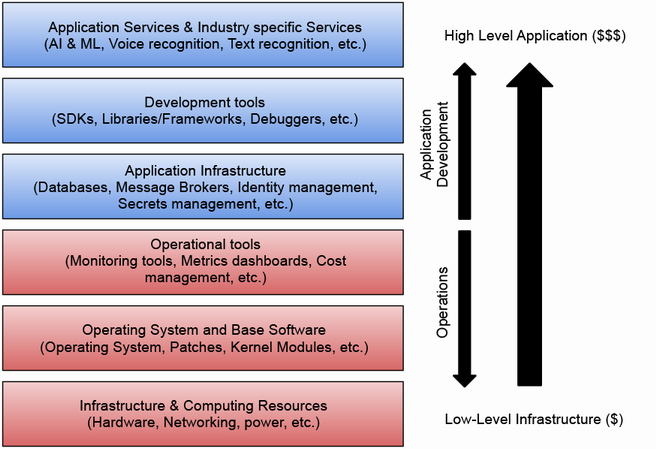
Compare provider offerings by their progression from low-level infrastructure resources to high-level application and industry services. section 1.1.1


How Platform Engineering on Kubernetes covers it

How deep it goes
Explains service layers, managed-service trade-offs, and API tooling, but stops short of defining cross-provider standards.
Examples
Uses layered service categories, managed PostgreSQL provisioning, provider tooling, and AWS, Google Cloud Platform, and Microsoft Azure.
What it assumes
Assumes teams can compare cloud operations with on-premises ownership and consider organizational policies or industry regulations.
What you can do after
Operate cloud services through APIs, SDKs, CLIs, and dashboards while weighing cost, operational ownership, delivery, and compliance.
How it connects
Connects cloud providers with APIs, SDKs, CLIs, dashboards, platform engineering, managed services, and Kubernetes.

Also explained in

Compare how 4 books explain cloud provider →

Related concepts

This explainer was generated by Manning's knowledge graph from the text of Platform Engineering on Kubernetes. The section links point to the parts of the book it draws on.

