Cloud storage is remotely managed storage accessed over a network and provided as an infrastructure service.
Cloud storage provides an externally managed place to store application files such as videos. A dedicated storage microservice can expose that capability without coupling the rest of the application to a specific provider. section 4.4
Use cloud storage when the application needs:
A simple, managed file-storage solution that works during development and costs less to operate than maintaining storage inside the application cluster. section 4.4.5
Production clusters that remain stateless, allowing them to be destroyed and rebuilt without risking stored data. section 4.4.5
Provider flexibility: an abstraction can hide Azure Storage, AWS S3, or Google Cloud Storage behind the same application-facing service. section 4.4section 4.4.6
Video storage behind a microservice
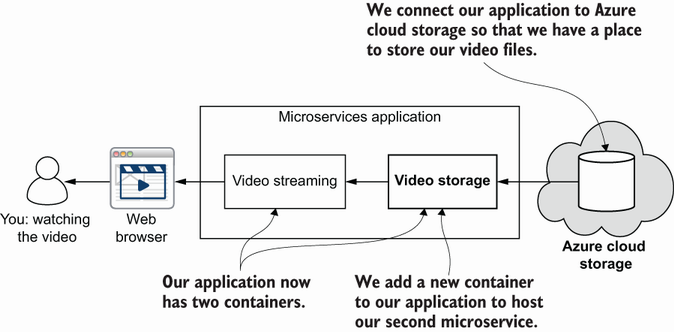
A video-streaming microservice forwards storage work to a video-storage microservice. That intermediary retrieves videos from external cloud storage, while the streaming service remains insulated from provider-specific implementation details. section 4.4.6section 4.5.5
Figure 4.5 We add a second microservice and external cloud storage to our application.
Trace the application layout: the video-storage microservice sits between the video-streaming microservice and external cloud storage. section 4.4
How Bootstrapping Microservices, Second Edition: With Docker, Kubernetes, GitHub Actions, and Terraform covers it
How deep it goes
Explains provider selection, service abstraction, stateless deployment, and replacement strategy, but defers customer video uploads.
Examples
Uses Azure Storage for application videos and compares it with AWS S3, Google Cloud Storage, and Kubernetes volumes.
What it assumes
Assumes Docker Compose and a microservices application, while deferring Kubernetes knowledge and customer upload implementation.
What you can do after
Build a file-storage microservice that can change providers with minimal disruption to the surrounding application.
How it connects
Connects cloud storage with microservices, Docker Compose, Kubernetes volumes, cluster storage, databases, and blue-green deployment.
MotherDuckused by · MotherDuck is a cloud service that extends DuckDB with collaborative and cloud-based data analysis capabilities.
hybrid deploymentused by · Hybrid deployment is an arrangement that coordinates applications, workloads, data, or processing across multiple environments, such as on-premises infrastructure and cloud services.
stageused by · A Snowflake stage is a location that references or stores data files for loading into Snowflake.
Atlas Online Archiveused by · Atlas Online Archive is a MongoDB Atlas capability that automatically moves infrequently accessed or historical collection data to lower-cost archival storage while retaining query access.
agent orchestrationpart of · Orchestration is the coordination and sequencing of agents, services, tasks, or components to carry out a larger workflow or objective.
This explainer was generated by Manning's knowledge graph from the text of Bootstrapping Microservices, Second Edition: With Docker, Kubernetes, GitHub Actions, and Terraform. The section links point to the parts of the book it draws on.