A collaborative agent works directly alongside people, suggesting, iterating, and adapting as the user contributes. It treats human input as part of task execution rather than waiting for a final review. section 9.1.2
Design decisions shape whether collaboration builds trust or creates friction:
- Start with limited automation, collect performance data, and increase autonomy as results become consistently reliable. section 9.1.2
- Match the interaction model to users’ AI affinity; unfamiliar uncertainty can make human-in-the-loop interactions overwhelming. section 9.1.2
- Treat latency and language-model errors as product risks: slow collaboration disrupts work, while malformed tool calls or formatting errors can break later steps. section 9.3.1
AI-assisted development
Tools such as Windsurf, Cursor, and GitHub Copilot track user actions, prevent conflicting suggestions, and integrate code changes dynamically so AI contributions support rather than disrupt ongoing work. section 9.1.2
Figure 9.5 As the agent becomes more reliable, you can reduce human involvement, simplifying your UI.
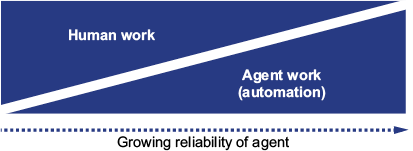
Use the figure to compare human involvement with agent reliability and see why greater reliability can support a simpler interface. section 9.1.2
