An AI interface is the user-facing interaction pattern through which people observe, direct, or collaborate with an AI agent. Effective designs balance automation with control and assign work deliberately between human and AI. section 3.4
Choose an interface according to how directly users need to participate:
- Conversational interfaces support natural dialogue but can feel linear and slow; streamed intermediate reasoning can improve transparency and trust. section 3.4 section 9.1.2
- Graphical interfaces organize agent activity visually, while hybrid interfaces combine graphical and conversational interaction. section 3.4
- Background agents work asynchronously and surface results through dashboards, email, or spreadsheets, reducing the need for continuous attention. section 9.1.2
- Collaborative agents suggest, iterate, and adapt beside users, supporting human–AI co-creation rather than fully autonomous execution. section 9.1.2
As an agent becomes more reliable, the interface can reduce human involvement. When uncertainty remains, the agent can treat the person as another tool and request clarification or missing data. section 9.1.2
Figure 9.5 As the agent becomes more reliable, you can reduce human involvement, simplifying your UI.
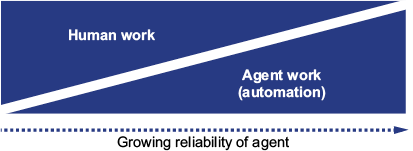
Use the reliability gradient to decide when an interface should expose more human control or simplify toward autonomous operation. section 9.1.2
