When two moviegoers like many of the same films, a recommender can use that overlap to suggest films one person liked to the other. Collaborative filtering makes recommendations from patterns in users’ preferences or behavior, without needing to categorize what users or items are about. section 2.3.2
The pattern can also come from items: “people who bought X also bought Y” recommends products often bought together. This flexibility lets systems recommend unrelated things, such as mattresses alongside books. Signals may be explicit, like ratings or likes, or implicit, like clicks and viewing time; these signals are not necessarily as informative as they first appear. section 2.3.2
Figure 2.7 An example of a user-item matrix for collaborative filtering. Each cell records the rating of each user for the corresponding item. Note that, in general, users don’t interact with all the items.
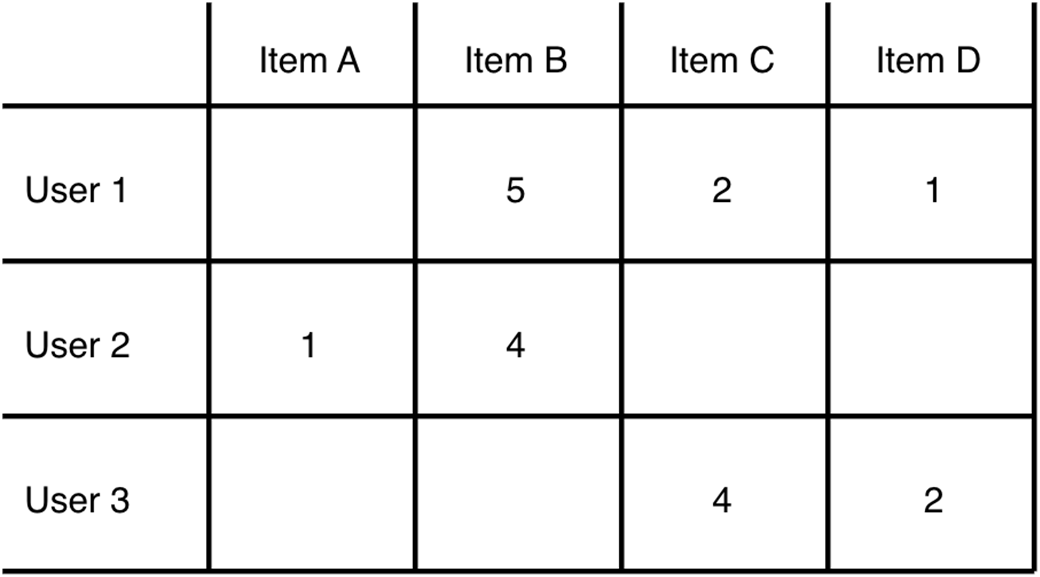
A user-item matrix shows how ratings can be recorded, including the gaps where users have not interacted with items. section 2.3.2