Common sense is the background knowledge people use to interpret everyday language: times of day, ordinary expectations, relationships, and unstated intentions. A phrase such as “good morning” depends on knowing that morning precedes afternoon and functions as a greeting rather than a factual report about morning. section 1.2.3
For language systems, commonsense knowledge helps to:
- Compress meaning: short utterances can communicate more when the listener supplies shared background knowledge. section 1.2.3
- Interpret relationships and expectations that are absent from a sentence’s literal wording. section 11.8
- Support chatbots that otherwise miss ordinary meanings, such as the significance of “which way is up.” section 11.8
Machines struggle because much commonsense knowledge is acquired informally before language, is rarely documented in a dedicated corpus, and may include instinctive expectations. Practical systems therefore use ontologies, knowledge bases, and knowledge graphs to represent and query relationships such as kind-of, is-used-for, has-a, and has-profession. section 1.2.3 section 11.8
From phrase to knowledge graph
Understanding a statement about a person may require facts about military ranks, titles, occupations, and how people relate to them. A knowledge graph can store these entities and normalized relationships so an information-extraction system can connect alternate names and related facts. section 11.8
Figure 11.4 Stanislav’s knowledge graph
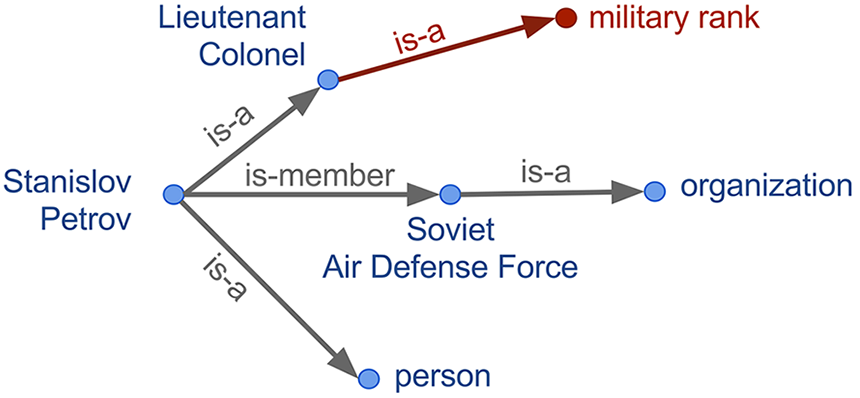
Inspect a concrete knowledge graph showing how entities and relationships can organize background knowledge. section 11.8



