Competitive advantage is a capability, asset, or position that helps a product or organization outperform competitors. In AI products, it comes from solving meaningful customer problems better than alternatives—not from adding AI for its own sake. section 2.2.3 section 2.0
A recommendation engine may deliver a quick win, but competitors can copy it quickly, leaving a thin moat. A unique dataset can make the same feature faster and more sustainably defensible. More ambitious capabilities, such as voice-activated search, may require longer investment but create stronger differentiation through user experience. section 2.2.3 section 2.2.3
Build competitive advantage by balancing immediate delivery with capabilities that become harder to copy:
- Use quick wins to gain AI experience or avoid falling behind, while recognizing that they may be table-stakes features. section 2.2.3
- Reserve capacity for long-term opportunities whose user value, accumulated learning, data, or delivery methods can become more defensible. section 2.2.3 section 12.1
- Align data science, engineering, user experience, and domain expertise around user-centered goals and measurable outcomes. section 12.1
Figure 2.1 This chapter addresses discovery in the opportunity space in the mental model of an AI system.
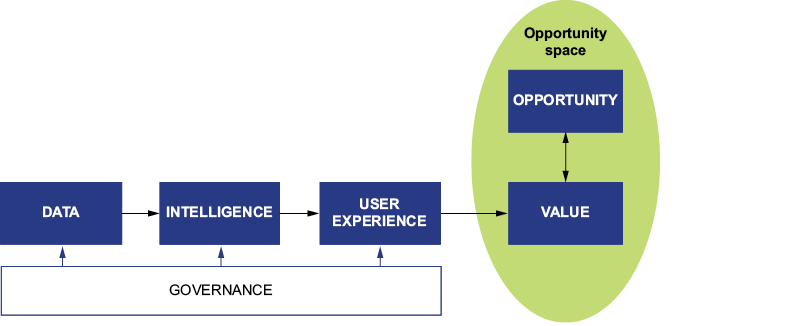
Use the opportunity-space model to connect customer needs, feasibility, business impact, and strategic advantage before selecting an AI initiative. section 2.0