liveBook · Manning

Conceptual schema

As explained in Graph Neural Networks in Action

A conceptual schema specifies graph elements, rules, and constraints without being tied to a particular database or processing system.

A conceptual schema is a database-independent blueprint for a graph. It identifies nodes, edges, properties, real-world entities, relationships, and the rules or constraints governing what the graph can represent. section 8.2.2

Use a conceptual schema to make graph design understandable before choosing an implementation:

  • Describe whether the graph has multiple node or edge types. section 8.2.2
  • State which real-world entities and relationships the elements represent. section 8.2.2
  • Record representation constraints and communicate the design through diagrams or written documentation. section 8.2.2
At left is the relationship nomenclature for ER diagrams. At right is an example of a conceptual schema using an ER diagram.
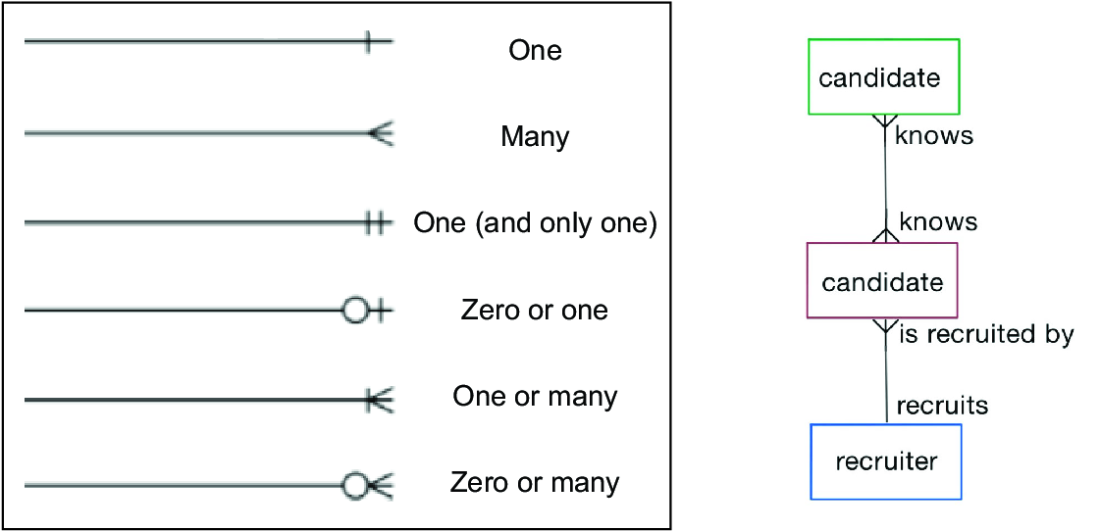
sidebar figure

An ER-diagram view helps communicate relationship nomenclature alongside a concrete conceptual schema. section 8.2.2


How Graph Neural Networks in Action covers it

How deep it goes
Defines elements, entity mappings, type variation, and constraints, but stops short of system-specific implementation details.
Examples
Uses writers and literary works, ER diagrams, and schemas with progressively varied node and edge types.
What it assumes
Assumes basic awareness of graph elements while defining schema, ontology, property graph, and RDF terminology.
What you can do after
Evaluate and communicate graph designs independently of a chosen database or processing system.
How it connects
Connects ontology, property graphs, RDF graphs, graph schemas, and system schemas.

Also explained in

Compare how 2 books explain conceptual schema →

Related concepts

This explainer was generated by Manning's knowledge graph from the text of Graph Neural Networks in Action. The section links point to the parts of the book it draws on.