A conceptual schema is a focused representation of the entities, relationships, properties, and types that express a domain’s essential model. It removes technical metadata and implementation details so people and language models can reason about the graph more reliably. section 14.6.1
A practical transformation pipeline turns a technical graph schema into a usable conceptual schema:
- Extract the technical schema with Neo4j’s apoc.meta.schema procedure. section 14.6.1 section 15.1.3
- Filter technical nodes, relationships, internal identifiers, timestamps, redundant labels, and unused properties with a skip list. section 14.6.1 section 15.1.3
- Enrich the remaining elements with business descriptions, property context, domain terminology, and constraints. section 15.1.3
- Serialize the result in a concise format that supports language-model prompting and Cypher generation. section 14.6.1 section 15.1.3
Vehicle ownership schema
A concise schema can define Vehicle with properties such as color, make, model, style, and plate_number, then represent OWNED_BY as a relationship to Person. The relationship may retain a business-relevant since: DATE property. section 14.6.1
Figure 14.8 The technical schema obtained through the APOC call is filtered so it is reduced to the conceptual graph schema representation. The conceptual schema is then mapped into a textual format that can be effectively understood by LLMs.
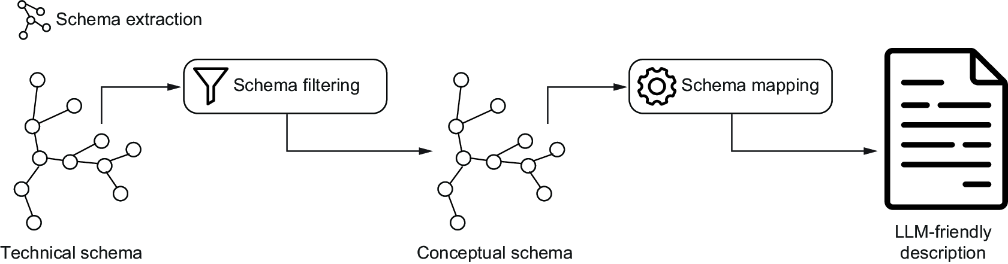
Use the transformation architecture to trace how a technical schema is filtered and mapped into a textual conceptual representation for LLMs. section 14.6.1

