Conflict resolution selects the value that remains when concurrent writes assign different values to the same data. ScyllaDB resolves these conflicts with last write wins: each update receives a microsecond-precision timestamp, and replicas eventually converge on the value with the latest timestamp. section 6.1.2
Edith and Emily edit an author bio
Edith updates a bio with QUORUM consistency. Emily writes milliseconds later with ONE consistency, so only one node initially acknowledges her update. Emily still wins because her write has the later timestamp, which eventually replicates to all replicas. This can lose Edith’s update because timestamps cannot represent additional editing context. section 6.1.2
Figure 6.1 In Scylla, the write timestamp of a query takes precedence over the number of replicas a node is stored on.
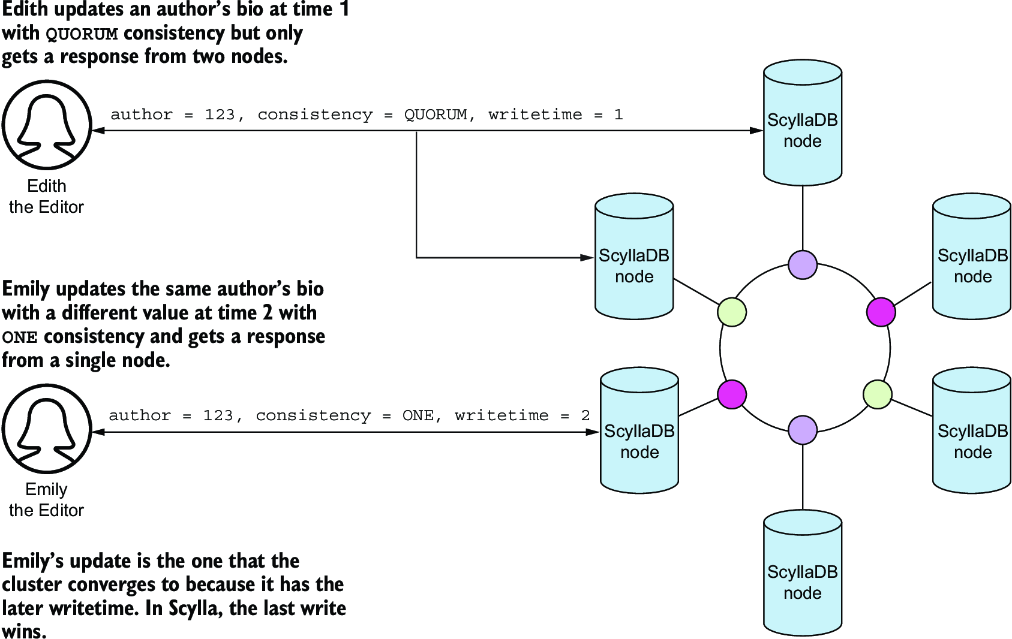
Compare replica count with write timestamps: the newer timestamp takes precedence, even when the older value exists on more replicas. section 6.1.2
Prevent lost updates with conditional updates or client-side coordination such as distributed locking. Query timestamps can also be overridden explicitly, so stale timestamps do not replace newer cell values. section 6.1.2



