A consumer group lets multiple consumers collaborate on reading Kafka topics. In the classic consumption model, each partition is assigned to only one member of a group at a time. Members divide the work; a different group can read the same topic independently. A service often uses one group, but a group need not map to exactly one service. section 4.1 section 4.2.1
Partition count limits how far a classic group can scale: adding consumers cannot create more simultaneous partition assignments than there are partitions. One consumer can also handle every partition when parallel processing is unnecessary. Where records sharing a key must remain ordered, routing them to one partition keeps their processing with one group member; changing the partition count can disrupt that routing. section 2.2.2 section 2.2.3 section 4.3.1
Figure 4.4 Assignment of the topic partitions to the consumer instances within a consumer group
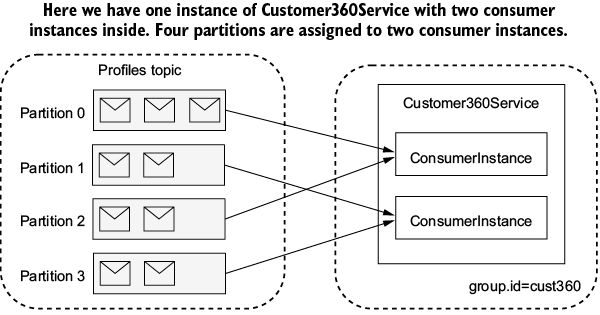
The partition-assignment diagram shows how group members divide a topic without assigning a partition to two members in the classic model. section 4.2.1
A customer-data consumer service
Consumers reading customer profiles and transactions can share a group.id while subscribing to different topics. Distinct client.id values help monitor and debug them. Group coordination does not, however, make concurrent updates to the same database aggregate safe: the two sets of consumers can overwrite one another, requiring a separate safeguard such as optimistic locking. section 4.2.2 section 4.2.13
Committed offsets are tracked per group, so committing a record's position needs care: marking it read does not necessarily mean processing finished. Consumer lag indicates how far a group is behind and helps guide scaling decisions. Failures or membership changes can trigger a rebalance that redistributes partitions. section 4.1 section 4.2.4 section 4.3.1 section 8.1.2
Record the intended consumption model when designing a topic. The one-member-per-partition rule describes classic groups; shared consumer groups, introduced in Kafka 4.0, permit a partition to be assigned to multiple consumers within a group. That distinction changes the assignment constraint and should not be inferred from group.id alone. section 10.1.3



