liveBook · Manning

Containerd

As explained in Acing the Certified Kubernetes Administrator Exam, Second Edition

Containerd is a lightweight, portable container runtime that implements the Container Runtime Interface.

containerd is a lightweight, portable, CRI-compliant container runtime. Running on each Kubernetes node, it provides the engine that runs application containers. section 1.6

Kubernetes treats the runtime as an external dependency rather than installing it itself. A cluster therefore requires a CRI-compatible runtime, such as containerd, cri-containerd, or CRI-O. section 1.6

Verify containerd operationally with Kubernetes and CRI tooling:

  • Run kubectl get no -o wide and read the CONTAINER-RUNTIME column. section 2.1.4
  • Inspect a pod with kubectl describe po to find a containerd:// container ID. section 1.6
  • Use crictl ps to list containers through the CRI interface. section 2.1.4

Confirm the runtime in kind

kubectl get no -o wide reports containerd://1.7.18 for a kind control-plane node. In a multinode cluster, the same check can show containerd://1.7.24 on both control-plane and worker nodes. section 2.1.4

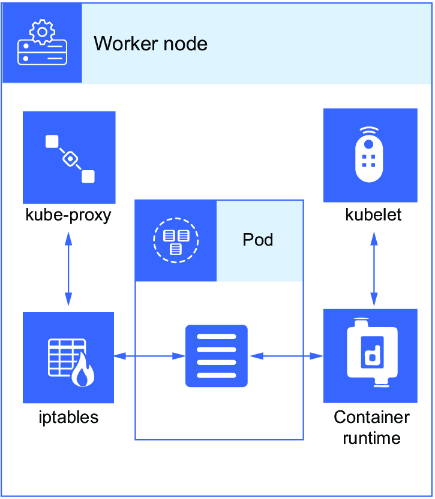
Figure 1.9 The role of the worker node is to run the application workloads. It also contains kubelet, kube-proxy, and the container runtime (e.g., containerd).
figure

Use the worker-node architecture to place containerd alongside kubelet and kube-proxy, with the node running application workloads. section 1.6


How Acing the Certified Kubernetes Administrator Exam, Second Edition covers it

How deep it goes
Defines the runtime’s role and demonstrates identification and inspection, stopping short of installation or configuration procedures.
Examples
Uses kubectl get no -o wide, kubectl describe po, crictl ps, and kind cluster output to verify runtime behavior.
What it assumes
Assumes basic Kubernetes node and pod knowledge while establishing CRI as the runtime interface from the operational examples.
What you can do after
Diagnose runtime selection and inspect CRI-managed containers with kubectl and crictl.
How it connects
Connects containerd with Kubernetes worker nodes, kubelet, CRI, kube-proxy, pods, and alternative runtimes such as CRI-O.

Also explained in

Compare how 3 books explain containerd →

Related concepts

This explainer was generated by Manning's knowledge graph from the text of Acing the Certified Kubernetes Administrator Exam, Second Edition. The section links point to the parts of the book it draws on.
