Authenticity concerns whether a person, identity, expression, or creative work appears genuine and trustworthy. Synthetic media makes that judgment harder: convincing fabrications can imitate real images, videos, and recordings, while authentic evidence may be dismissed as fake. section 4.3
Synthetic media creates competing effects around authenticity:
- It can protect authenticity’s human value by anonymizing people without removing the emotional force of their stories. section 4.3
- It can weaken trust through fabricated evidence, impersonation, fraud, harassment, and the liar’s dividend—the false claim that genuine evidence is synthetic. section 4.3
- It can complicate judgments about identity and creative responsibility when fictional influencers present racial, cultural, or gendered identities. section 4.6
Authenticity in public-facing media
Lil Miquela is an entirely fictional influencer assembled through artificial intelligence technologies, 3D modeling, human writing, and marketing. Her realistic public persona demonstrates how audiences may engage with creative work that is persuasive without representing a real person. section 4.6
Figure 4.5 AI-generated interpretations of ketchup: a Van Gogh–style painting of a swirling ketchup landscape, a crayon drawing of a ketchup bottle by a toddler, and a surrealist painting of a ketchup bottle melting over a clock
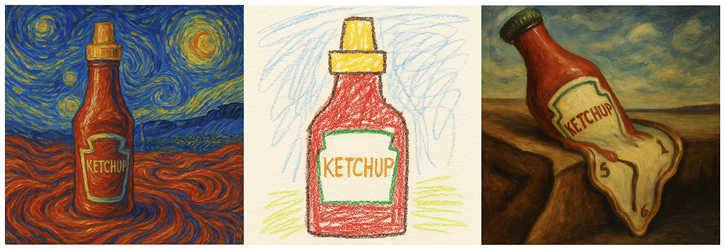
Compare three AI-generated ketchup images in distinct artistic styles to consider how style, authorship, and perceived originality shape judgments of authenticity. section 4.6



