Output filtering checks generated responses after model inference and before delivery. A post-call pipeline can enforce policies and formatting, redact sensitive or unintended information, log responses, detect hallucinations, and convert outputs into structured downstream actions. section 2.4.1
Filtering can reduce harm when a model retains personal information: preventing it from displaying information about an individual may mitigate an erasure request when deletion is not technically feasible. It does not remove the underlying data from the model. section 5.5.1
Account for the limits of this control:
- Vendor-provided safety policies and moderation filters can complement an organization’s pre-call controls. section 2.3.2
- Output filters and contractual clauses may limit exposure from a model’s training data, but do not cover copyrighted material supplied through RAG or fine-tuning. section 6.6.3
Generated code and copyleft
A coding assistant might suggest a snippet nearly identical to GPL- or AGPL-licensed code. Output filters may limit some training-data exposure, but do not address copyrighted material introduced through RAG or fine-tuning. section 6.6.3
Figure 2.5 Shared responsibilities across organizations (client, vendor, LLM provider) in the Self-Hosted Model adoption model: This architecture assumes the LLM (e.g., Mistral, Llama 3) is deployed on organization-managed infrastructure (e.g., cloud or on-prem). All inference traffic, safety filtering, and post-processing are managed internally. In multi-tenant systems, organizations often share centralized model serving and safety services but must enforce tenant-scoped access controls and storage partitioning for RAG, prompts/secrets, and logs to avoid cross-tenant data exposure.
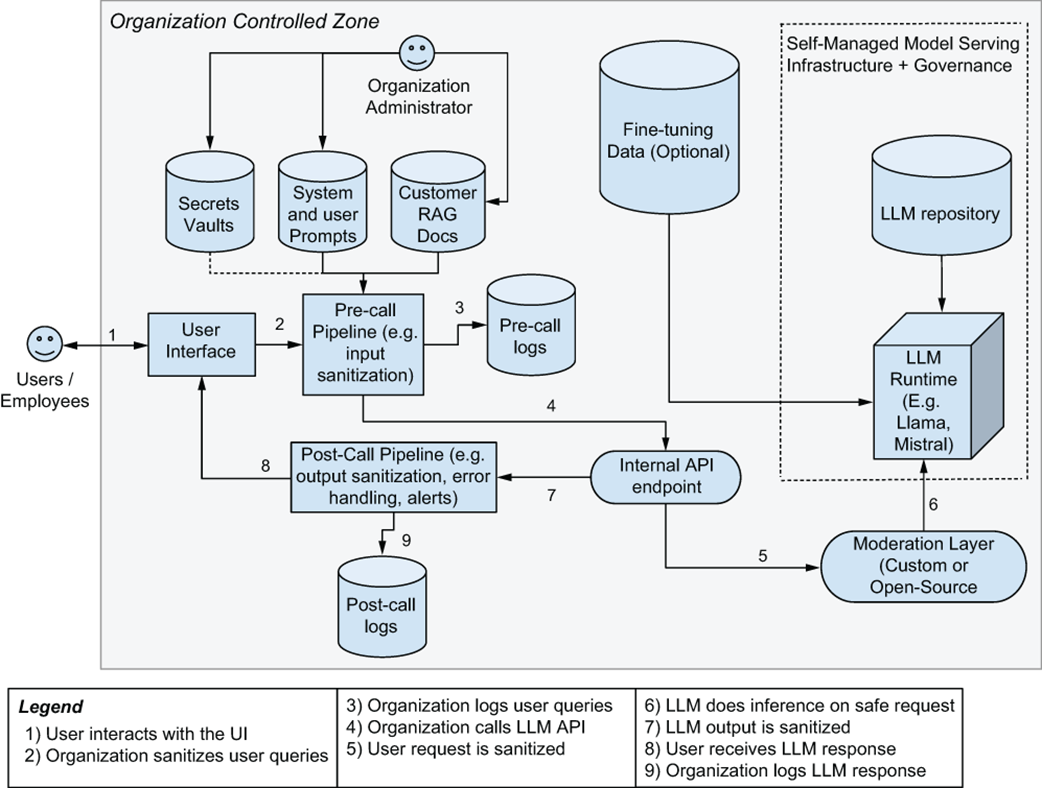
See how a self-hosted deployment places inference, safety filtering, and post-processing under internal management, with tenant-scoped controls needed in multi-tenant systems. section 2.4.1




