liveBook · Manning

Continuous integration

As explained in Google Anthos in Action

Continuous integration is a software development practice in which code changes are frequently integrated into a shared codebase and validated by automated builds and tests.

Continuous integration (CI) is a software development practice in which developers check in code frequently—at least daily—and automatically build and test each integrated change. It creates reliable, repeatable builds and a fast feedback loop. section 12.1

A CI workflow typically combines:

  • A Git source repository for storing and versioning application code. section 12.4
  • A CI server that automates validation, builds, and tests after integration. section 12.1 section 12.4
  • A container registry for storing built container images. section 12.4
  • Code reviews, testing, and container-image builds before deployment continues. section 12.0

Anthos application workflow

A developer changes a Python or Go Hello World application, previews it during continuous development, commits it to Git, and triggers CI for code review, testing, and container-image builds. Operators then configure Kubernetes deployments for development, test, and production environments. section 12.0
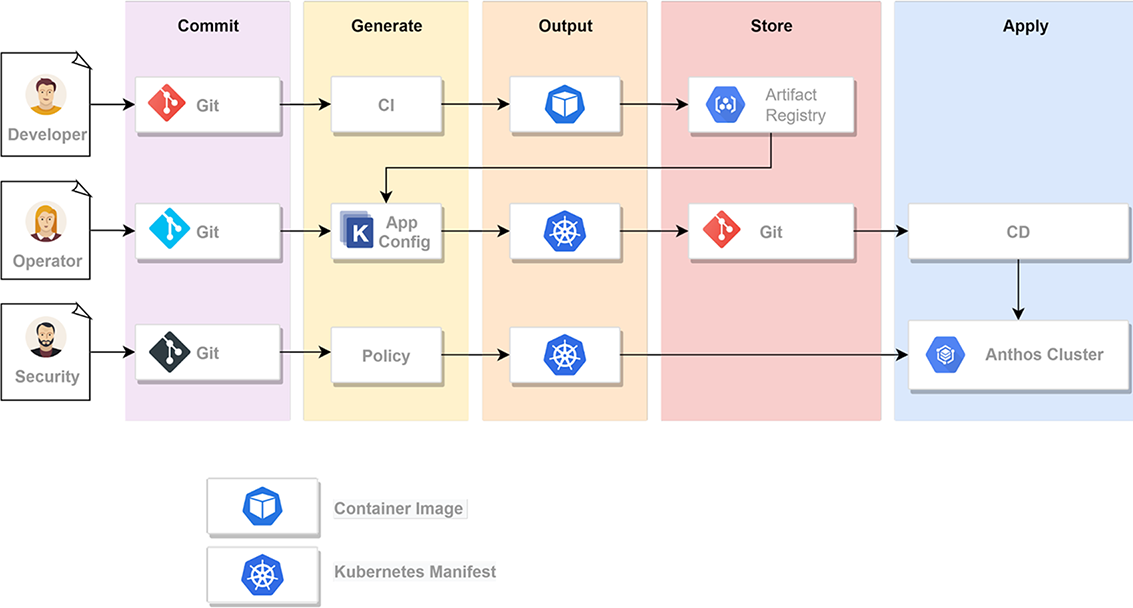
Figure 12.1 The CI/CD workflow
12-01

Use the CI/CD workflow diagram to trace how development, integration, and deployment activities connect. section 12.0


How Google Anthos in Action covers it

How deep it goes
Defines the practice and identifies repositories, registries, and CI servers, but defers detailed tool configuration.
Examples
Uses an Anthos Hello World application implemented in Python or Go and integrated through Git, testing, and container-image builds.
What it assumes
Assumes application development and Git usage while introducing the CI/CD workflow and its core components.
What you can do after
Apply CI by integrating changes frequently and validating them through automated builds and tests.
How it connects
Connects continuous integration with Git, code review, automated testing, container images, Kubernetes, and continuous delivery.

Also explained in

Compare how 3 books explain continuous integration →

Related concepts

This explainer was generated by Manning's knowledge graph from the text of Google Anthos in Action. The section links point to the parts of the book it draws on.