liveBook · Manning

Continuous integration

As explained in Kargo in Action

Continuous integration is the practice of automatically building and testing changes and publishing the resulting artifacts.

Continuous integration (CI) builds and tests artifacts, then publishes them to a repository. Its responsibility ends when the artifact is published; it does not govern which version moves into each environment or reconcile cluster state. section 1.2

The delivery stack separates three responsibilities:

  • CI produces artifacts. section 1.2
  • Promotion governs artifact movement between environments. section 1.2
  • A GitOps agent reconciles cluster state with configuration declared in Git. section 1.2
Figure 1.2 The three-layer Kubernetes delivery stack. CI produces artifacts; Kargo governs their promotion across environments; Argo CD reconciles the cluster state with what Git declares. Each layer has a single focused responsibility, and Kargo is the only one that addresses which artifact version belongs in which environment.
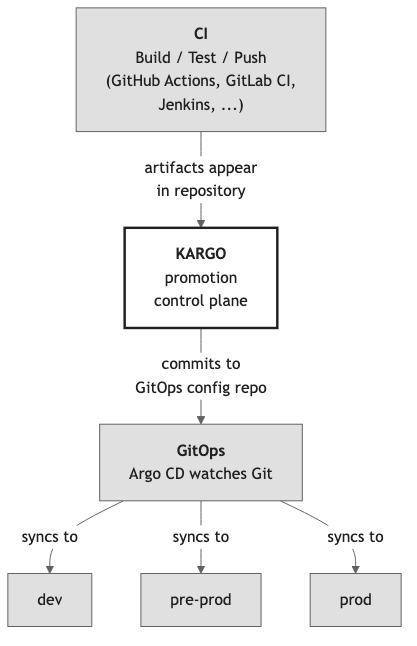
The three-layer Kubernetes delivery stack

Use the delivery-stack diagram to distinguish artifact production from promotion and cluster reconciliation. section 1.2


How Kargo in Action covers it

How deep it goes
Defines CI’s artifact-publishing boundary and distinguishes its role from promotion and cluster reconciliation.
Examples
Names GitHub Actions, GitLab CI, and Jenkins as CI systems.
What you can do after
Evaluate CI’s boundary by identifying artifact publication as its endpoint, before promotion or cluster reconciliation.
How it connects
Connects CI with artifact repositories, promotion, and GitOps agents such as Argo CD and Flux.

Also explained in

Compare how 7 books explain continuous integration →

Related concepts

This explainer was generated by Manning's knowledge graph from the text of Kargo in Action. The section links point to the parts of the book it draws on.