A control plane manages a distributed application's deployment and operation; a separate data plane handles application requests. In a workflow platform, the control plane packages code, creates container replicas, registers routes, monitors health, and scales workloads, while SDK runtime servers execute inside those containers. section 9.0 section 9.8
The separation assigns responsibilities according to when and where they must run:
- Deployment-time concerns include packaging workflow code, creating Kubernetes deployments, registering API Gateway routes, and configuring autoscaling. section 10.12
- Request-time concerns remain in the data plane: containers receive HTTP requests, invoke workflow functions, and coordinate platform-service calls. section 9.0
- Synchronous and streaming requests bypass the control plane, while asynchronous workflows call it to create and manage job state. section 9.0
- Scaling and resource settings flow through deployment; timeouts and retry behavior remain enforced inside the container runtime. section 9.8
Scaling an asynchronous research workflow
A research workflow can return a job ID immediately, fan out searches across several child workflows, and later synthesize their results. The control plane independently scales those stateless containers, while sessions, memory, credentials, and other state remain in platform services. section 10.12
Figure 9.1 Control plane vs. data plane. On the left, the Workflow Service (control plane) connects to Kubernetes to manage container Deployments and to the API Gateway to register routes. On the right, the data plane: multiple workflow containers, each running the SDK's runtime server, receiving HTTP requests from the API Gateway and making gRPC calls to platform services through the gateway. For synchronous and streaming workflows, the control plane and data plane do not communicate during request handling. For asynchronous workflows, the data plane calls the control plane to manage job state.
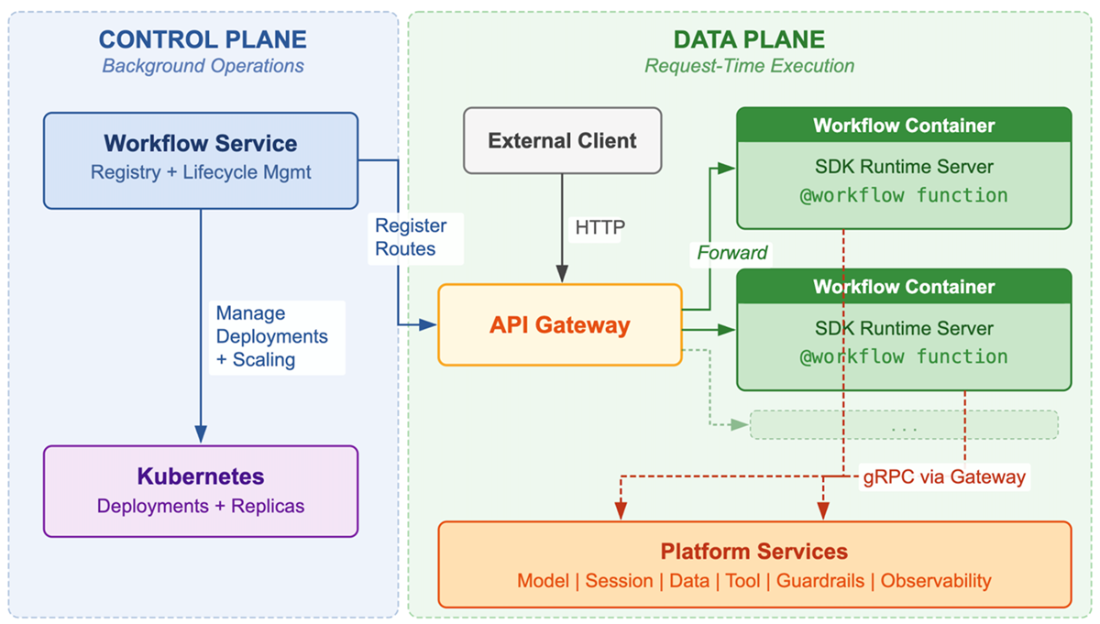
Trace deployment and request traffic across the control plane, data-plane containers, Kubernetes, API Gateway, and platform services. section 9.0









