liveBook · Manning

Convex hull

As explained in Build AI Drug Discovery Pipelines

A convex hull is the smallest convex region containing a specified set of points.

A convex hull is the smallest convex region containing all training points in descriptor space. For molecular solubility models, it provides a more precise applicability domain than descriptor-wise minimum and maximum bounds. section 4.1.3

Use the convex hull to:

  • Assess whether a new molecule lies within the region represented by the training data. section 4.1.3
  • Avoid some empty regions that a bounding box falsely labels as reliable and account for descriptor relationships. section 4.1.3
  • Recognize that computation becomes unwieldy as descriptor dimensionality increases and that the method retains some bounding-box limitations. section 4.1.3
Figure 4.6 Estimated model AD based off of regions defined by the bounding box (dashed line) and convex hull (dotted line) methods.
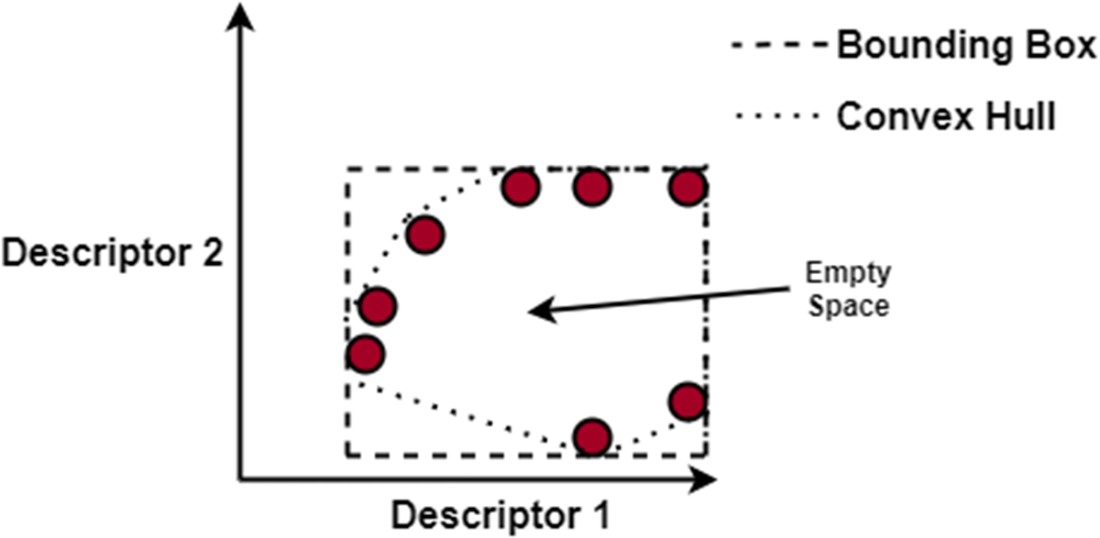
Compare the convex-hull applicability domain with the broader bounding-box region in descriptor space. section 4.1.3


How Build AI Drug Discovery Pipelines covers it

How deep it goes
Defines the enclosing convex region and explains dimensionality, empty-region, and inherited reliability limitations.
Examples
Contrasts convex-hull and bounding-box regions for descriptor-based solubility models.
What it assumes
Assumes molecular descriptors and training data, while positioning the method after bounding-box reasoning.
What you can do after
Evaluate whether a molecule lies inside a descriptor-space applicability domain while recognizing the method’s limits.
How it connects
Connects applicability domains with molecular descriptors, training data, bounding boxes, and distance-based methods.

Also explained in

Compare how 5 books explain convex hull →

Related concepts

This explainer was generated by Manning's knowledge graph from the text of Build AI Drug Discovery Pipelines. The section links point to the parts of the book it draws on.


