liveBook · Manning

CPU

As explained in GPU Programming with Triton

A central processing unit is a general-purpose processor optimized for low-latency sequential and moderately parallel execution.

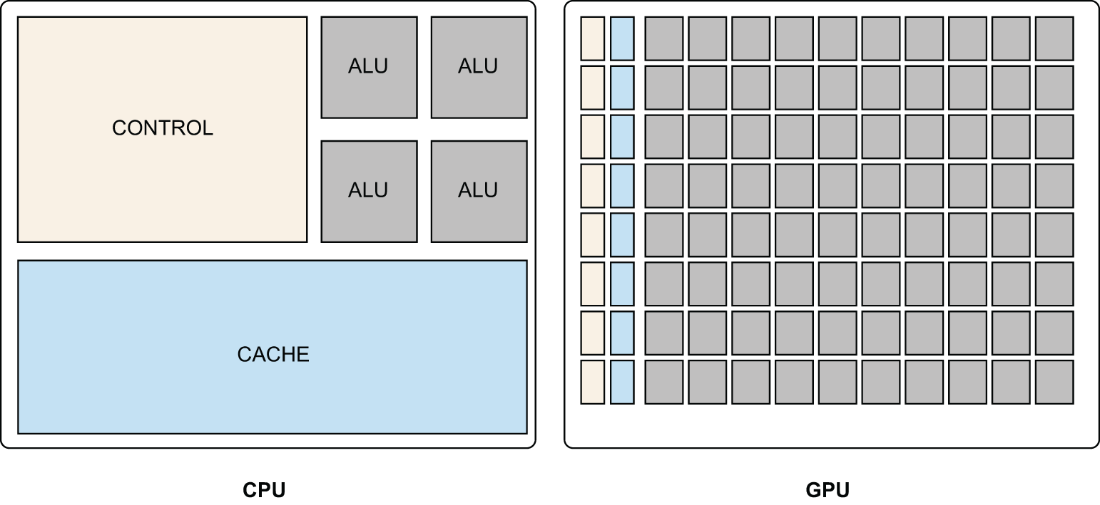
A CPU is optimized to finish individual tasks quickly. Its few fast cores use large caches and sophisticated control logic to support sequential execution. section 1.3.2

In GPU programming, the CPU is the host: it organizes and launches Triton kernels, which execute on the GPU. This contrasts with the GPU’s emphasis on throughput across many simple arithmetic units. section 1.5

Figure 1.5 GPUs dedicate more of their area to compute and less to control and caching.
Growth in training data

Compare how CPU and GPU chip area is allocated to computation, control, and caching. section 1.3.2


How GPU Programming with Triton covers it

How deep it goes
Explains latency-oriented design through core count, caches, and control logic.
Examples
Compares CPU and GPU chip-area allocation with a design diagram.
What you can do after
Understand how CPU latency optimization contrasts with GPU throughput and how the CPU launches GPU kernels.
How it connects
Contrasts CPU design with GPUs and connects the CPU to CUDA host-device roles and Triton kernel launches.

Also explained in

Compare how 9 books explain CPU →

Related concepts

This explainer was generated by Manning's knowledge graph from the text of GPU Programming with Triton. The section links point to the parts of the book it draws on.






