Critical path analysis identifies the dependent operations that determine whether a response or task meets its performance target. It starts with user goals—such as time to content, interaction latency, or task completion—and works backward to find what must finish before the user can proceed. section 4.0
Apply the method by:
- Trace the operations required for the user’s goal, then distinguish blocking work from work that can happen afterward. section 4.0
- Prioritize changes that shorten the path: restructure data flow for parallelism, cache important data, and reduce initial client-side work. section 4.0
- Move nonessential logging, metrics reporting, and secondary data requests into background or deferred execution when they do not affect completion. section 4.1
- Use the path to guide service boundaries and data-fetching architecture, since splitting required operations across network calls can add latency. section 4.1
Checkout and dashboard flows
A checkout flow with instant product selection still feels slow if payment processing blocks completion. Likewise, a dashboard that loads quickly remains frustrating when filtering takes three seconds. The optimization target is the operation controlling the user’s goal, not whichever code happens to look slowest. section 4.0
Mobile startup
A mobile startup sequence may fetch secondary data before using cached primary content. Tracing the sequence reveals that fresh data is blocking information the user needs immediately; using the cache first removes unnecessary waiting. section 4.1
Figure 4.1 Critical path and deferred work. The critical path blocks the user while deferred work happens afterward without affecting what they experience.
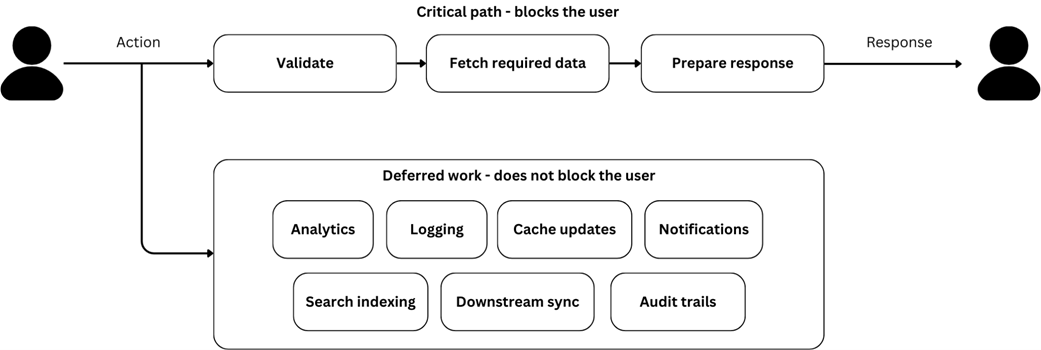
Use the figure to distinguish work that blocks the user from deferred work that continues without changing the immediate experience. section 4.0

