A customer journey maps how an actor interacts with a product or service to achieve a goal. It captures the persona, scenario, goal, major stages, and actions performed at each stage. section 5.3.1
Use the journey to examine an API from the consumer’s perspective:
- Work backward from the end-user journey before reviewing the external API and the internal services it depends on. section 5.3.1
- Draft guide documentation alongside the OpenAPI definition to expose usability and documentation problems early. section 5.3.1
- Extend the map into a service blueprint by connecting user actions with provider APIs and other service components. section 5.3.1
For API products, the developer journey adapts the model to discovery, evaluation, build, production usage, and scaling. Each stage records the developer’s job and product touchpoints, creating places to measure experience and performance. section 11.1.2
Developer journey metrics
Map a developer’s path from discovering an API through production and scaling, then attach metrics to its touchpoints. Relevant measures include sign-ups, time to first hello world, daily active users, time to first transaction, retention, conversion, and top consumers. section 11.1.2 section 11.4
Figure 5.8 When reviewing an external API, where possible, work backward by reviewing the user journey map before reviewing the external API. This presumes that you have a user journey map prepared. Review the external API before reviewing any internal service APIs they depend on.
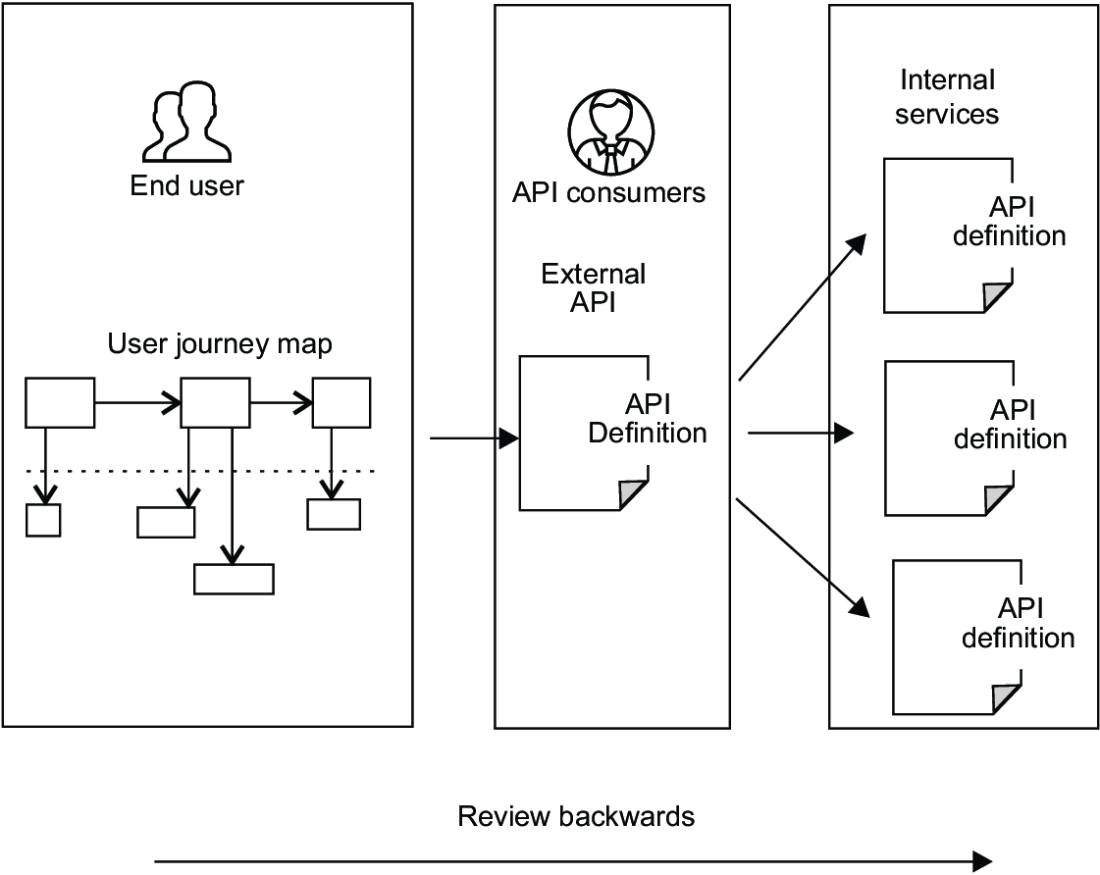
Review the journey map before the external API, then inspect dependent internal service APIs to preserve an outside-in review order. section 5.3.1





