A customer journey map is a visual narrative of one target user’s experience across connected product touchpoints. It follows what the person does, thinks, and feels while pursuing a specific goal, then turns positive and negative moments into opportunities for improvement. Unlike a user flow, which clarifies task steps, a journey adds context and emotion. section 5.2 section 5.2.2
Build a useful journey map by narrowing the perspective and connecting actions to experience:
- Choose one target user persona rather than combining audiences with different behaviors. section 5.2.2
- Define a specific scenario, goal, or task, and limit its scope so the map produces focused insights. section 5.2.2
- Map each scenario step to what the user may be thinking, doing, or feeling, including positive and negative moments. section 5.2.2
- Identify opportunities to improve the experience, using user research to avoid assumptions about the user’s point of view. section 5.2 section 5.2.2
- Include relevant digital and physical touchpoints when the experience crosses between spaces. section 5.2.2
Booking a train ticket
A journey map can follow one person booking a train ticket through an app, recording each stage of the scenario alongside the person’s actions, thoughts, feelings, and improvement opportunities. A healthcare journey might similarly connect a website visit with the physical experience of visiting a provider. section 5.2.2
Figure 5.7 A simple user journey map that depicts the scenario of a user booking a train ticket and their experience with the app. User journey maps can be created with tools such as Figma, Illustrator, or even Microsoft Word.
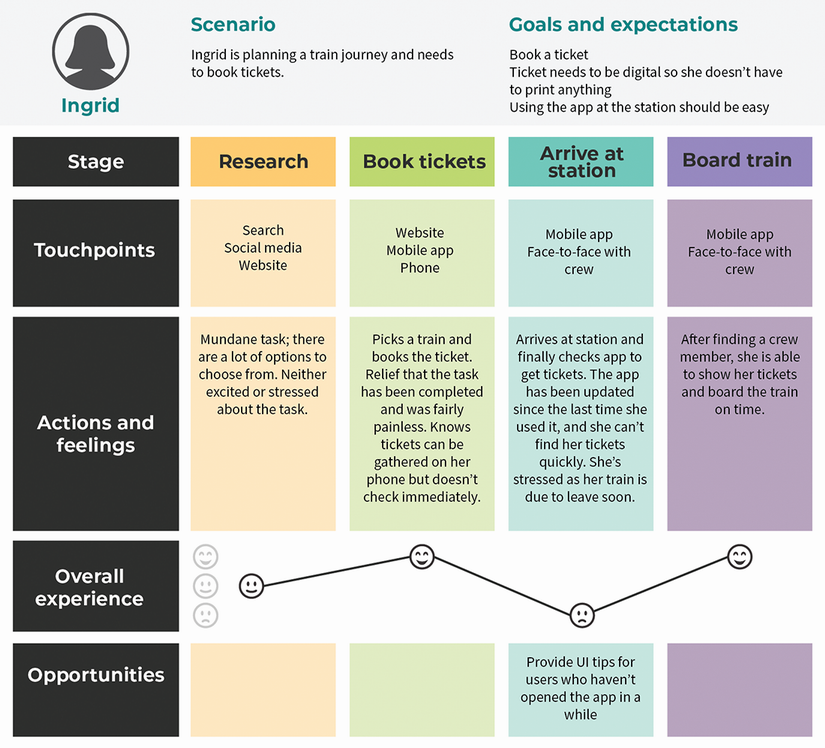
Inspect a simple journey map for booking a train ticket; journey maps can be created in Figma, Illustrator, or Microsoft Word. section 5.2.2





