A customer journey maps the stages, experiences, interactions, touch points, and channels a customer encounters while pursuing an outcome with an organization. It takes the customer’s perspective and offers a broader view than a user journey, which focuses mainly on product interactions. section 12.2.1 section 2.1
Use a customer journey to:
- Include interactions with marketing, customer service, employees, products, and physical or digital channels. section 12.2.1
- Expose customer pain points and opportunities that may be missed when teams focus directly on software features. section 2.1 section 12.7
- Bring UX, product, development, and architecture perspectives into a shared modeling effort. section 12.2.2
Aligning BigScreen’s journey with EventStorming
UX designers had mapped BigScreen’s customer journeys, while another group had modeled the broader business picture with Big Picture EventStorming. Because the journeys were stored separately and known mainly to UX, the wider group could not use them to identify architectural hotspots or opportunities. Bringing the maps into the EventStorming session creates a basis for validation and alignment. section 12.2.2 section 12.7
Figure 12.4 A simple customer journey of BigScreen, with details removed from it
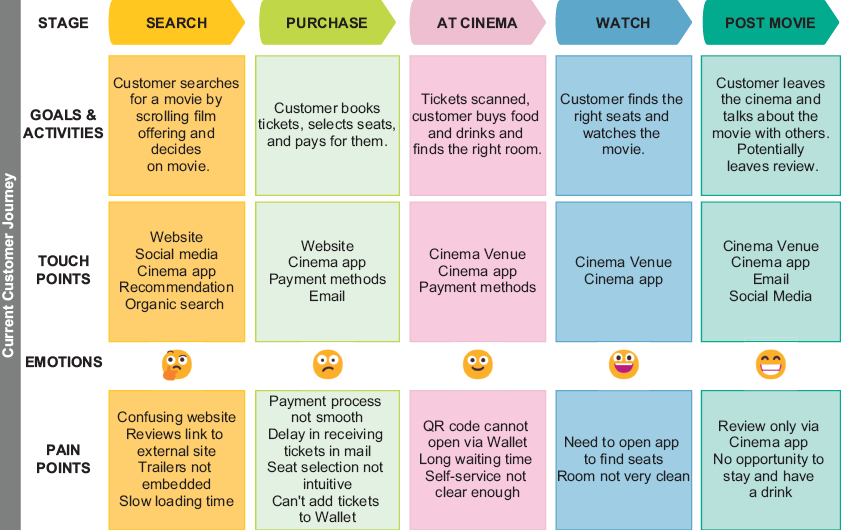
Browse a simplified visual example of BigScreen’s customer journey. section 12.2.1





