A cycle is a graph path that starts at a node and returns to that node without retracing steps or repeating intermediate nodes. Cycles may occur in directed or undirected graphs; acyclic graphs contain no such return path. section 1.2.2
Use these distinctions when modeling or validating graph data:
- A cyclic graph permits a circular path; an acyclic graph does not. section 1.2.2
- A directed acyclic graph (DAG) has directed edges and forbids cycles, supporting one-way causal, workflow, and dependency relationships. section 1.2.2
- During testing, inspect isolated groups whose relationships form a cycle and verify that data models and analytical tools handle them correctly. section 8.2.4
Figure 1.4 A cyclic graph (left), an acyclic graph (right), and a DAG (bottom). In the cyclic graph, the cycle is shown by the arrows (directed edges) connecting nodes A-E-D-C-B-A. Note that two nodes, G and F are part of the graph, but not part of its defining cycle. The acyclic graph is composed of undirected edges, and no cycle is possible. In the DAG, all directed edges flow in one direction, from A to F.
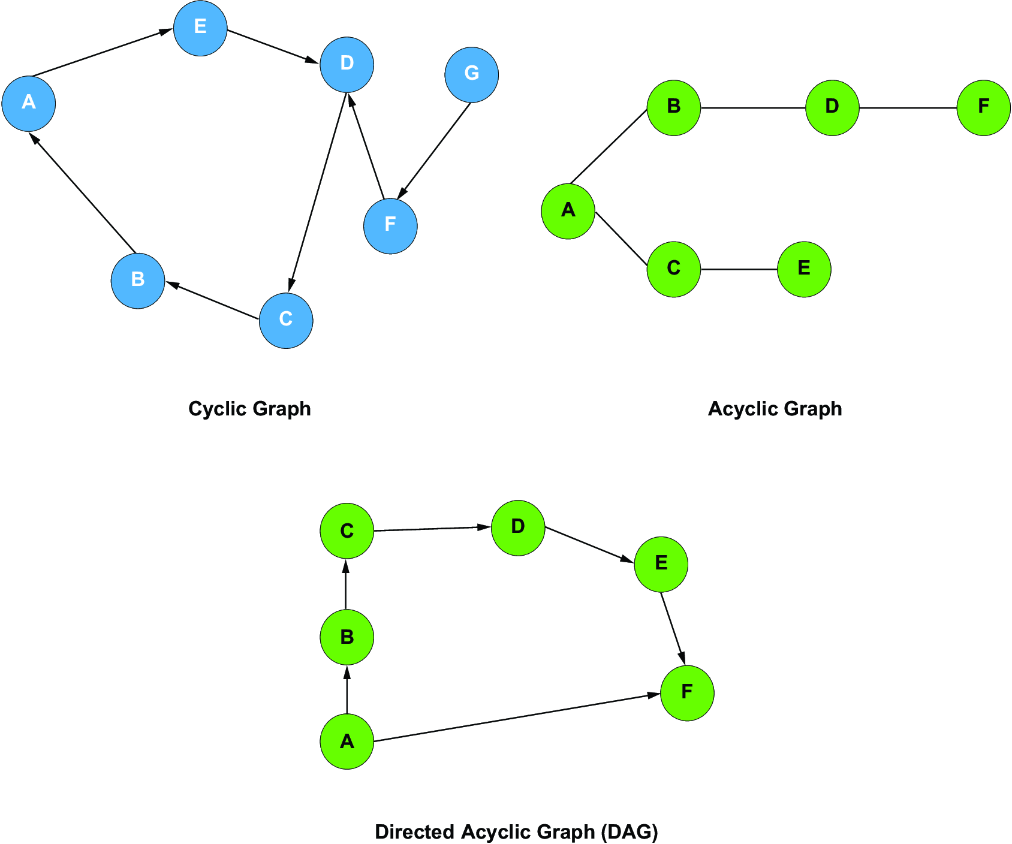
Compare a cyclic graph, an acyclic graph, and a DAG; the cyclic example follows A-E-D-C-B-A, while other nodes may remain outside the cycle. section 1.2.2




