Cycle time measures the elapsed time from a developer starting a task to its pull request being merged. It exposes delivery speed without treating developer opinion as evidence. AI-assisted coding usually accelerates implementation, but not the thinking, design, or review that surrounds it. section 9.4.2
Interpret cycle-time changes with the surrounding engineering signals:
- Expect the largest gains on medium-complexity work; simple tasks have little implementation overhead, while complex tasks remain constrained by design and review. section 9.4.2
- Pair cycle time with pull-request throughput and first-attempt success rate; faster completion can otherwise hide smaller PRs, retry costs, or quality regression. section 9.4.2
- Treat a sustained increase as a diagnostic signal, not proof of AI-tool failure; investigate configuration drift, project complexity, and team changes. section 9.4.4
A measurable rollout
A team tracking medium-complexity tasks recorded a 25–35% cycle-time reduction after adopting AI coding assistance. The result was smaller for simple and complex work, so the team also monitored PR size, merge throughput, and review success instead of equating speed with feature output. section 9.4.2
Figure 9.7 Visualization of the potential dashboard - state of the art.
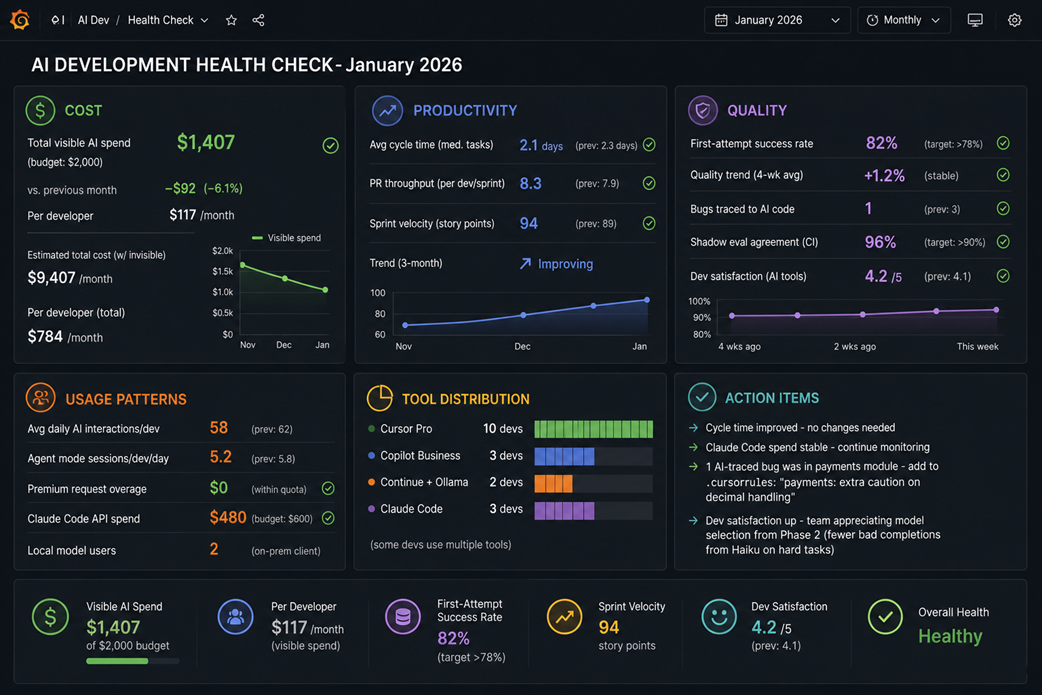
A health-check dashboard makes cycle time actionable by pairing the metric with explicit investigation rules, such as reviewing tooling drift after two consecutive monthly increases. section 9.4.4




