Dask is a Python package for processing, analyzing, and training models on large datasets, including datasets that do not fit in RAM. It offers a route beyond single-core pandas workflows by parallelizing work across available CPU cores or across multiple machines. section 8.0 section 8.1
Its central behavior is lazy evaluation: reading data, filtering rows, creating features, and preparing a model can be recorded as a directed acyclic graph (DAG) rather than run immediately. Calling compute() requests the result and executes the needed preceding work. section 8.1 section 8.1.1
Figure 8.2 This diagram shows a sample Dask workflow DAG, staring with reading in a dataset, followed by a few steps ending in training a model. Dask can store the steps in a workflow like this as a DAG. When a step in the DAG needs to output the results from previous steps, then the preceding steps in the DAG workflow will be executed.
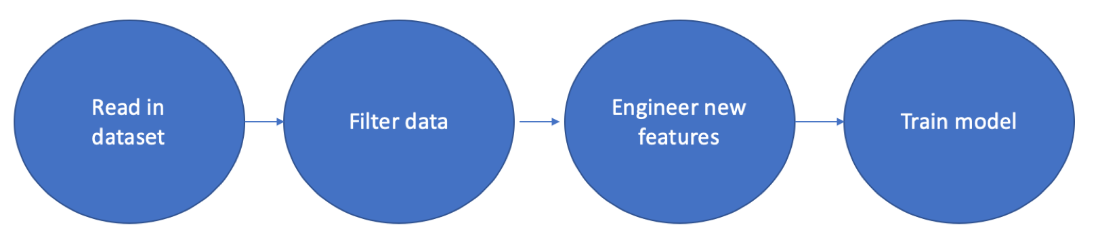
The workflow diagram makes lazy evaluation concrete: a dataset read, filter, feature steps, and model training are stored as connected work until an output is needed. section 8.1
A practical Dask workflow can follow familiar dataframe steps:
- Install Dask and its machine-learning package with pip, then import dask.dataframe as dd. section 8.1
- Read only needed Parquet columns with dd.read_parquet; the quick setup does not mean the full dataset has been loaded into memory. section 8.1
- Use dataframe operations such as filtering, groupby, describe, value_counts, and mean; append compute() when results are required immediately. section 8.1.1
- Create feature columns and split data into training and test sets with dask_ml.model_selection.train_test_split. section 8.1.2
Analyze ad clicks on a local cluster
Create a LocalCluster and Client to use the CPU cores on one machine. Load click and site_category columns, group rows by site_category, calculate the mean click value, and call compute(). Because click is binary, the mean gives the proportion of ads clicked in each category. The same pattern supports descriptive statistics and category counts. section 8.1.1
Dask also extends the workflow into machine learning. A local setup can combine Dask data loading, feature creation, train/test splitting, joblib parallelization, and scikit-learn’s RandomForestClassifier to predict ad clicks. This helps where chunking with pandas and scikit-learn cannot support an intended algorithm, such as random forests or gradient boosting. section 8.1.3 section 8.1.5
Start locally when available cores are enough, then scale the same general approach to a remote cluster when data or runtime needs grow. The local-versus-remote change is presented primarily as choosing LocalCluster or a remote cluster object. section 8.1.1 section 8.1.5



