Pandas
pandas is an open-source Python library providing labeled data structures and tools for manipulating and analyzing tabular and other structured data.

Pandas Workout: 200 exercises to make you a stronger data analyst
An open-source Python library for data analysis and manipulation, including labeled tabular data structures.
- How it is used
- Applies pandas to loading, cleaning, analyzing, and comparing real-world data sets.
- How deep it goes
- Explains Series indexing, alignment, broadcasting, and substantial data-frame analysis without cataloging all pandas capabilities.
- Examples
- Uses monthly test scores, New York City taxi passenger counts, and Python and Stack Overflow survey data.
- What you can do after
- Apply it via pandas to load, clean, join, analyze, and visualize data frames and Series.
Read how Pandas Workout: 200 exercises to make you a stronger data analyst explains pandas →
Machine Learning for Tabular Data: XGBoost, Deep Learning, and AI
pandas is an open-source Python library providing data structures and operations for manipulating and analyzing structured and tabular data.
- How it is used
- Supports loading, assembling, cleaning, and exploring tabular data before data analysis or machine learning.
- How deep it goes
- Demonstrates DataFrame construction, indexing, readers, merges, and exploratory commands without detailing pandas internals.
- Examples
- Uses a labeled four-person table, merged product tables, and the Auto MPG dataset in fixed-width and CSV forms.
- What you can do after
- Apply it via pandas to load, merge, inspect, summarize, and visualize mixed-type tabular datasets.
Read how Machine Learning for Tabular Data: XGBoost, Deep Learning, and AI explains pandas →
The Well-Grounded Data Analyst
pandas is a Python software library for working with tabular and labeled data, including data manipulation and analysis.
- How it is used
- Supports exploratory preparation of tabular data before metrics, visualizations, segmentation, forecasting, or interactive prototypes.
- How deep it goes
- Demonstrates executable concatenation, inspection, grouping, correction, merging, and filtering, while deferring specialized statistics, forecasting, and clustering to other libraries.
- Examples
- Uses combined November–December product events and a Streamlit house-price explorer with geographic filters, median prices, charts, and raw-data tables.
- What you can do after
- Apply it via pandas to prepare, validate, transform, summarize, and filter large tabular datasets for analysis or prototypes.

Starting Data Analytics with Generative AI and Python
pandas is a Python library providing labeled data structures and tools for manipulating and analyzing tabular data.
- How it is used
- Uses pandas DataFrames to explore data quality and filter customer reviews in analytical workflows.
- How deep it goes
- Demonstrates inspection, grouping, and filtering with worked code; the review search remains basic and leaves missing-value handling for further work.
- Examples
- Examines customer identifier relationships and filters Portuguese customer reviews using positive keywords.
- What you can do after
- Apply pandas to inspect DataFrames, compare identifier counts, and produce a basic keyword-filtered review dataset.
Read how Starting Data Analytics with Generative AI and Python explains pandas →

Cyber Threat Hunting
pandas is an open-source Python library for manipulating and analyzing tabular and labeled data.
- How it is used
- Supports beaconing hunts by preparing and analyzing network-event tables.
- How deep it goes
- Demonstrates practical DataFrame loading, conversion, grouping, filtering, deduplication, and plotting rather than pandas internals.
- Examples
- Uses 667,827 network events, connection tuples, destination IPs, web paths, line plots, and histograms.
- What you can do after
- Apply it via pandas to filter and summarize network events for beaconing investigation.

The Quick Python Book, Fourth Edition
pandas is an open-source Python library for data analysis that provides labeled data structures and operations for manipulating tabular and other structured data.
- How it is used
- Uses pandas to clean, explore, combine, and summarize tabular data.
- How deep it goes
- Works through DataFrame creation, cleaning, merging, filtering, aggregation, and simple plotting, while leaving many features to further exploration.
- Examples
- Uses a numbered grid, Mars weather JSON, temperature CSV, and sales-call and revenue tables.
- What you can do after
- Applies pandas to load, clean, merge, filter, summarize, and plot small datasets.
Read how The Quick Python Book, Fourth Edition explains pandas →
Fast Python: High performance techniques for large datasets
- How it is used
- Uses pandas as an in-memory analytics tool and a baseline for comparison with Dask.
- How deep it goes
- Works through loading, memory, computation, and chunking optimizations, while treating Arrow integration as a primer rather than a full Arrow treatment.
- Examples
- Uses New York taxi trips for loading and tip calculations, and state tax data for cleaning, pivoting, and calculating proportions.
- What you can do after
- Apply pandas to load and analyze data, benchmark performance alternatives, and process files in chunks.
Read how Fast Python: High performance techniques for large datasets explains pandas →
Statistics Every Programmer Needs
pandas is a Python software library for data manipulation and analysis, especially with tabular and labeled data.
- How it is used
- Supports data preprocessing, exploration, summarization, visualization, and preparation for statistical or predictive modeling.
- How deep it goes
- Demonstrates import, inspection, encoding, grouping, and visualization, but does not descend into pandas internals.
- Examples
- Uses a raisin CSV data set, DataFrame inspection, categorical encoding, grouped statistics, histograms, and correlation heat maps.
- What you can do after
- Apply pandas to load, inspect, clean, transform, summarize, and visualize tabular data for downstream analysis.
Read how Statistics Every Programmer Needs explains pandas →
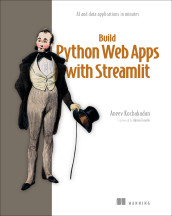
Build Python Web Apps with Streamlit
pandas is a Python library for data manipulation and analysis, especially with labeled and tabular data.
- How it is used
- Supports loading, inspecting, selecting, wrangling, and visualizing tabular data in interactive Streamlit dashboards.
- How deep it goes
- Explains installation, CSV loading, dataframe inspection, column selection, and visualization preparation without detailing advanced dataframe operations.
- Examples
- Uses sales_data.csv, a large sales dataframe, column subsets, dataframe inspection, and dashboard charts as concrete examples.
- What you can do after
- Build data-loading and dashboard workflows that inspect, select, and prepare tabular records for interactive analysis and charts.
Read how Build Python Web Apps with Streamlit explains pandas →

Grokking Machine Learning
Pandas is an open-source Python library for manipulating and analyzing structured, especially tabular, data.
- How it is used
- Loads, manipulates, and saves datasets for data preparation before machine-learning modeling.
- How deep it goes
- Demonstrates CSV loading, inspecting dimensions and columns, selecting fields, and counting values; notes missing data but does not detail cleaning procedures.
- Examples
- Uses Titanic passenger data to inspect columns and count survival outcomes.
- What you can do after
- Apply Pandas to load a CSV, inspect its dimensions and columns, select fields, and count values.
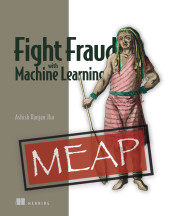
Fight Fraud with Machine Learning
pandas is a Python library for data manipulation and analysis, especially with labeled tabular data.
- How it is used
- Supports inspecting tabular fraud data before extracting rules or training models.
- How deep it goes
- Demonstrates loading, previewing, sizing, summarizing, typing, and binary-feature inspection, without covering pandas internals.
- Examples
- Uses a phishing webpage dataset with 10,000 rows, 50 columns, numerical features, and a binary fraud label.
- What you can do after
- Apply it via pandas to load a fraud CSV and inspect its dimensions, statistics, types, features, and labels.
Read how Fight Fraud with Machine Learning explains pandas →

Natural Language Processing in Action, Second Edition
pandas is a Python library for manipulating and analyzing labeled tabular and time-series data.
- How it is used
- Converts token-count dictionaries into labeled tabular vectors for text analysis.
- How deep it goes
- Explains DataFrame construction, missing-value filling, integer conversion, vocabulary columns, and vector arithmetic, but defers later high-dimensional improvements.
- Examples
- Uses 16 bias-related documents to produce a 246-column document-term matrix from token counts.
- What you can do after
- Apply pandas to construct, inspect, and normalize labeled text-count matrices.
Read how Natural Language Processing in Action, Second Edition explains pandas →
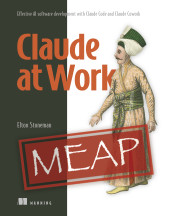
Claude at Work
pandas is a Python library for data manipulation and analysis using labeled tabular structures.
- How it is used
- Supports local analysis of downloaded CSV datasets through model-written Python code executed in a sandbox.
- How deep it goes
- Demonstrates querying, aggregation, and statistical functions in a data-analysis workflow without detailing pandas’ API.
- Examples
- Uses Our World in Data files to explore internet users, researchers, and space launches by country.
- What you can do after
- Apply it via pandas to analyze local CSV datasets with querying, aggregation, and statistical functions.
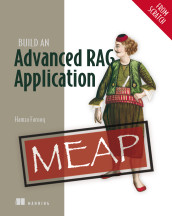
Build an Advanced RAG Application (From Scratch)
Pandas is a Python library for manipulating and analyzing structured tabular data.
- How it is used
- Supports semantic-search data preparation by converting, inspecting, filtering, and analyzing loaded tabular records.
- How deep it goes
- Demonstrates DataFrame creation, row inspection, locality filtering, and value counting without covering advanced pandas behavior.
- Examples
- Uses a hotel dataset, a train split, head(), Paris locality filtering, and hotel-name value counts.
- What you can do after
- Apply it via pandas to turn a loaded dataset into a filtered DataFrame for semantic-search preparation.
Read how Build an Advanced RAG Application (From Scratch) explains pandas →
Also covered in
- Learn AI-Assisted Python Programming, Second Edition
- Build a Robo-Advisor with Python (From Scratch)
- Data Pipelines with Apache Airflow, Second Edition
- Learn AI Data EngineeringIn early access (MEAP)
- DuckDB in Action
- Software Engineering for Data ScientistsIn early access (MEAP)
- Grokking Machine Learning, Second EditionIn early access (MEAP)
- Data Analysis with LLMs
- Bayesian Optimization in Action
- The Complete Obsolete Guide to Generative AI
- Python How-To
- Data-Driven Cybersecurity
What to know first
- PythonPython is a high-level, general-purpose, dynamically typed programming language with readable syntax and support for multiple programming paradigms.
- CSVCSV is a text format for tabular data in which records contain fields separated by commas, with conventions for quoting fields that contain special characters.
- data frameA data frame is a two-dimensional tabular data structure organized into labeled rows and columns, often with columns that can contain different types of values.
- medianThe median is the middle value in an ordered set of observations, or the average of the two middle values when the set has an even number of observations.
Related concepts
- read_csvused by · read_csv is a function that parses comma-separated or otherwise delimited text into a tabular data structure.
- data groupingused by · Data grouping is the partitioning of data elements into groups according to shared values or other criteria, enabling group-specific processing or analysis.
- data frameuses · A data frame is a two-dimensional tabular data structure organized into labeled rows and columns, often with columns that can contain different types of values.
- CSVuses · CSV is a text format for tabular data in which records contain fields separated by commas, with conventions for quoting fields that contain special characters.
- Pythonuses · Python is a high-level, general-purpose, dynamically typed programming language with readable syntax and support for multiple programming paradigms.
- datasetuses · A dataset is an organized collection of related data items, records, observations, or examples treated as a unit for storage, processing, or analysis.
Questions about pandas
What is pandas?
pandas is an open-source Python library providing labeled data structures and tools for manipulating and analyzing tabular and other structured data.
Which Manning books explain pandas?
Pandas Workout: 200 exercises to make you a stronger data analyst, Machine Learning for Tabular Data: XGBoost, Deep Learning, and AI, The Well-Grounded Data Analyst, Starting Data Analytics with Generative AI and Python, Cyber Threat Hunting, The Quick Python Book, Fourth Edition, Fast Python: High performance techniques for large datasets, Statistics Every Programmer Needs and 6 more.
What should I know before learning pandas?
Manning books that teach pandas usually introduce Python, CSV, data frame and median first.
These guides are generated from the text of Manning books by Manning's knowledge graph and link to the sections they draw on. The full books are available on liveBook and at manning.com.