A retailer may need a publisher’s audience data to assess an advertising campaign, yet neither party wants to hand over its customer records. A neutral data clean room provides a controlled environment, operated by an independent intermediary, where partners can match and analyze combined data without revealing raw records to one another. Unlike a platform-owned clean room, it is not confined to one advertising ecosystem. section 8.1 section 8.1.2
A typical collaboration moves through three stages:
- Protect and contribute data: partners hash or otherwise mask identifiers, such as email addresses, before securely providing their datasets. section 8.2
- Match under agreed rules: the environment finds overlaps using protected identifiers and aggregates the results rather than exposing individual records. section 6.3.1 section 8.1
- Use protected outputs: partners receive aggregated insights or audience segments for analysis and campaigns. section 8.1 section 8.2
Figure 8.3 Neutral intermediary clean room—hashed data from multiple advertisers and publishers is routed through an independent AdTech environment for secure cross-platform matching, analysis, and delivery of aggregated insights
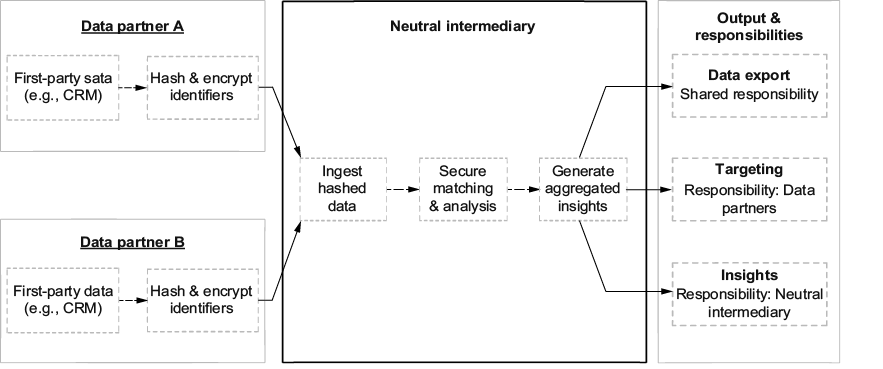
The neutral-intermediary diagram distinguishes cross-platform matching and aggregated reporting from collaboration restricted to a single advertising platform. section 8.1.2
A brand and publisher find an audience overlap
A sporting-goods brand contributes protected customer identifiers and purchase history; a fitness publisher contributes protected visitor identifiers and browsing behavior. Matching hashed email addresses helps them identify a relevant audience for fitness-tracker advertising without disclosing individual user information to each other. section 8.2.1
Neutrality offers room to combine multiple data sources and work across advertising platforms, but it can add cost. Secure pipelines and consistent identifiers also take effort, and interoperability among clean rooms remains a hurdle. Consent preferences still govern which data may be shared; a controlled environment is not a substitute for privacy governance. Beyond targeting, clean rooms support cross-channel measurement and collaborations such as fraud suppression. section 8.1.2 section 8.4 section 8.5 section 2.3.2
