Customer information is often split among websites, loyalty programs, publishers, and purchase records. Data matching identifies records that correspond across these sources. In marketing, those overlaps can support audience targeting, campaign measurement, or the exclusion of customers who should not receive an offer. section 8.2 section 8.3.1
A data clean room provides a controlled place to match partner datasets without exchanging raw personal information. Partners hash or mask identifiers such as email addresses before upload. The clean room compares the resulting keys on predefined criteria, identifies matching records, and returns aggregated insights rather than exposing individual records. section 8.1 section 8.2
Figure 8.4 A high-level secure matching process in a data clean room
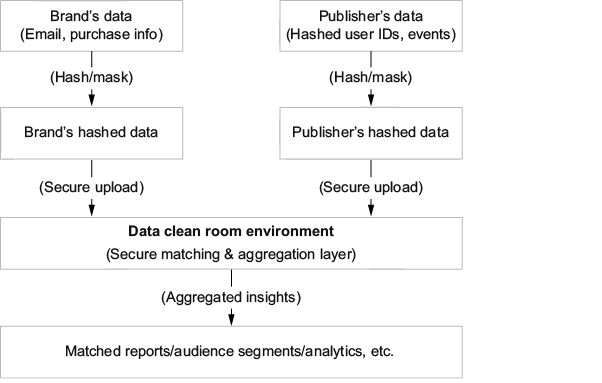
The workflow traces matching from protected identifiers and secure upload through to aggregated results. section 8.2
Find a shared audience
A sporting-goods brand uploads hashed customer email addresses and purchase history; a fitness publisher uploads hashed visitor email addresses and browsing behavior. Matching the email keys reveals an audience overlap without disclosing individual identities. The brand can use that overlap to target a fitness-tracker campaign on the publisher’s site. section 8.2.1
Choose a matching arrangement according to the decision it must support:
- For suppression, match an anonymized fraud list against a marketing list and exclude overlapping records from offers. section 8.3.1
- For measurement, connect protected identifiers and events across web, mobile, and connected TV to assess conversions and channel contribution. section 8.4
- For platform choice, weigh a walled garden’s integrated activation against its limited interoperability and visibility into matching. section 8.1.1
Matching still requires consistent identifiers, secure data pipelines, and privacy controls. Hashing and aggregation reduce exposure, but they do not remove the need to assess how data is shared; some jurisdictions may require a data protection impact assessment. The practical goal is useful overlap and measurement without unnecessary disclosure. section 8.4 section 8.1
