Fraud prevention means identifying suspicious activity early enough to stop a loss. Online purchases make that difficult: a seller cannot check a buyer face to face or readily verify that the buyer owns the card. Stolen card details, including details captured by skimmers, can be used for unauthorized purchases. section 10.1
For a card issuer, prevention can mean deciding whether to accept or decline a purchase within milliseconds. The system must assess transaction details while handling tens of thousands of transactions per second; delaying legitimate purchases is not a practical solution. section 3.2
A decision tree offers one way to make those decisions:
- Gather historical transactions, including amount, time, merchant type, location, and whether the card was present. A human must identify which recorded transactions were fraudulent. section 3.2
- Place useful questions early in the tree. If international purchases have a higher fraud rate than domestic ones, that distinction could form the first split. section 3.2
- Continue splitting each branch using the questions that best distinguish its transactions, then use the resulting tree to assess new purchases. section 3.2
Figure 3.1 The first few levels of a decision tree. In a real-world application, a full tree may contain thousands of nodes.
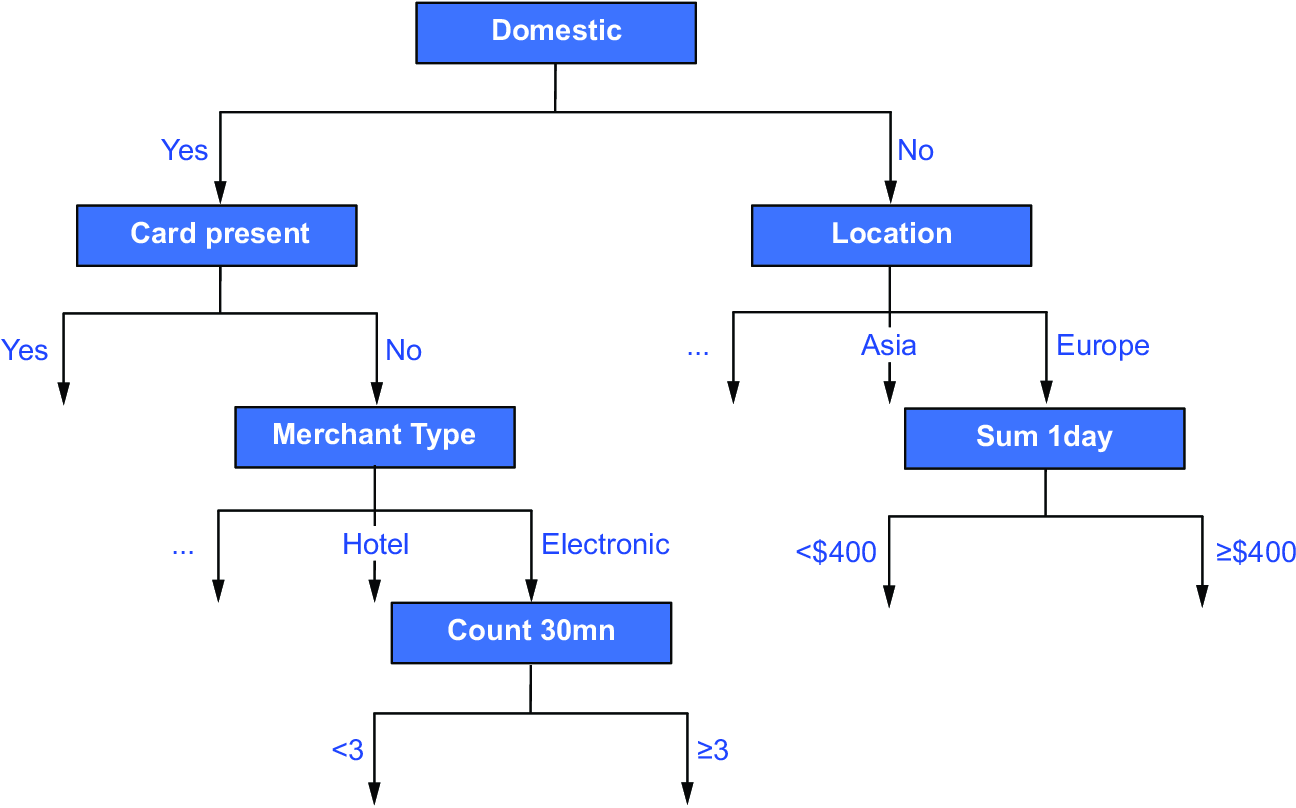
The diagram shows the first levels of a decision tree; a deployed tree may have thousands of nodes. section 3.2
A decision tree is not the only possible component. A proposed combination adds data mining for patterns, case-based reasoning for historical cases, fuzzy logic for uncertainty, deep learning for complex relationships, rules for interpretable decisions, and smart agents for monitoring. These are proposed complementary roles, not a guarantee that a combined system will catch every fraud attempt. Start with the decision the system must make, the labeled data available, and the speed it must sustain. section 11.7 section 3.2
