A data-driven approach infers decisions from collected data instead of relying on developers to write every rule. For recommendations, platforms can use users’ interactions to estimate their preferences at a scale that manual intervention cannot readily match. section 2.3.2
Recommendation systems can use different kinds of interaction signals:
- Explicit signals include ratings, likes, dislikes, and votes. section 2.3.2
- Implicit signals include dwell time, clicks, and how much of a video someone watches. section 2.3.2
Dogs or cats?
If someone sees content about both dogs and cats but interacts only with dog-related items, a platform might infer a preference for dogs. That is a useful guess, not a direct statement of preference. section 2.3.2
Figure 2.7 An example of a user-item matrix for collaborative filtering. Each cell records the rating of each user for the corresponding item. Note that, in general, users don’t interact with all the items.
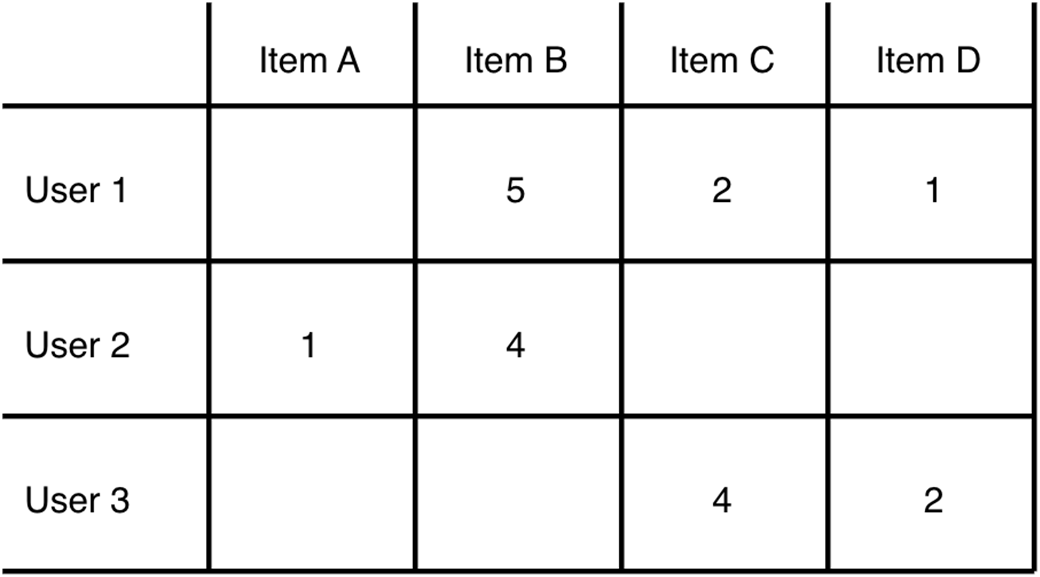
A user-item matrix shows ratings across users and items; many cells are empty because users do not interact with every item. Collaborative filtering uses other users’ preferences or behavior to make recommendations. section 2.3.2

