The data plane, also called the forwarding plane, handles the actual movement of network messages. It receives a packet or frame on one interface, performs required processing, and forwards it through another interface according to predetermined rules. section 22.2.1 section 22.4
Typical data-plane functions include:
- Forwarding or flooding frames using destination MAC addresses and the switch MAC address table. section 22.2.1
- Applying forwarding-related security decisions, including Port Security, DHCP Snooping, and Dynamic ARP Inspection. section 22.2.1
- Tagging frames with 802.1Q before sending them across trunk links. section 22.2.1
- Forwarding packets using routing-table instructions, while the control plane builds the tables that enable those decisions. section 22.2.1 section 22.4
Data plane in SDN
In traditional networks, each device forwards messages using locally available decisions. In software-defined networking, a controller can centralize some or all control-plane functions, while the data plane remains distributed across network devices and follows the controller’s instructions. section 22.4
Figure 22.2 The three logical planes. The Data Plane involves forwarding messages, the Control Plane controls how the Data Plane functions, and the Management Plane includes all configuration/management tasks.
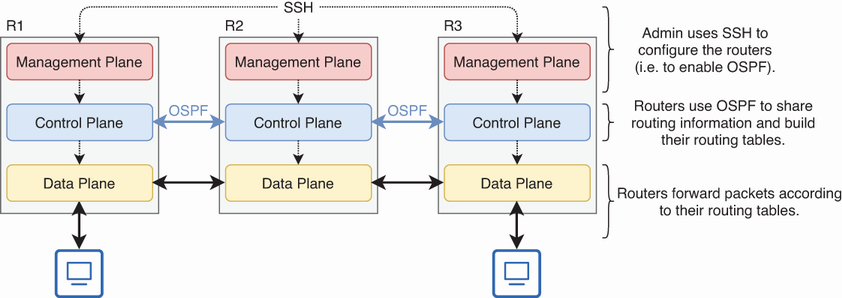
Use the logical-planes figure to contrast message forwarding in the data plane with control-plane and management-plane responsibilities. section 22.2.1



