liveBook · Manning

Data plane

As explained in Kubernetes in Action, Second Edition

The workload plane is the collection of worker resources on which applications run in a cluster.

The data plane, also called the workload plane, is the collection of worker nodes where applications and workloads run. Unlike the control plane, it does not control the cluster; it provides the resources that execute, monitor, and connect applications. section 1.2.3 section 1.2.1

Kubernetes turns the worker nodes into one deployment area accessed through the Kubernetes API. You deploy without choosing an individual node, and Kubernetes may later move an application between nodes. Each application still must fit on one worker node. section 1.2.1

Deploying onto the workload plane

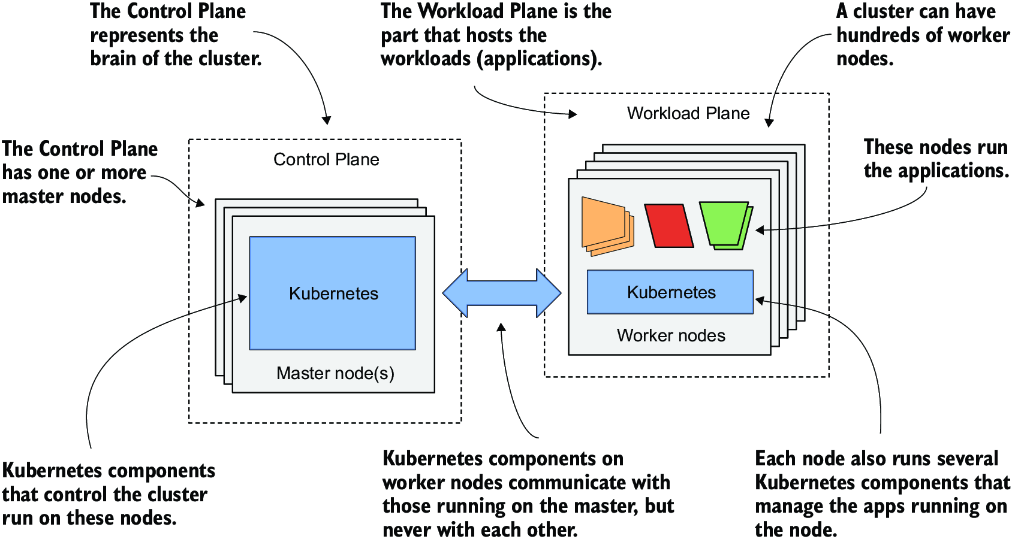
A cluster divides its machines into control plane nodes and worker nodes. An application submitted through the Kubernetes API is scheduled onto a worker node, where it runs as part of the workload plane; another worker node may host it later. section 1.2.1 section 1.2.3

Figure 1.11 The two planes that make a Kubernetes cluster
figure

Use the cluster-plane diagram to compare the control plane with the worker-node resources that form the data plane. section 1.2.3


How Kubernetes in Action, Second Edition covers it

How deep it goes
Defines the plane, its node membership, and deployment behavior while deferring component internals to later treatment.
Examples
Uses cluster diagrams and the scenario of deploying an application without selecting its worker node.
What it assumes
Assumes basic cluster deployment knowledge while defining worker nodes, control plane, and data plane terminology.
What you can do after
Operate Kubernetes deployments as a shared worker-node resource without coupling applications to individual machines.
How it connects
Connects worker nodes, the control plane, the Kubernetes API, scheduling, and application workloads.

Also explained in

Compare how 4 books explain data plane →

Related concepts

This explainer was generated by Manning's knowledge graph from the text of Kubernetes in Action, Second Edition. The section links point to the parts of the book it draws on.

