liveBook · Manning

Data scientist

As explained in Delivering Machine Learning Projects: From design to deployment

A data scientist is a specialist who conditions data, creates models, and tests and evaluates their effectiveness.

A data scientist conditions data, creates models, and tests and evaluates their effectiveness. The role addresses challenges spanning data, modelling, and domain alignment within an ML project team. section 3.2.2

Place the role alongside complementary specialists:

  • Data engineers handle data resources, platforms, tooling, security, costs, and efficiency. section 3.2.2
  • ML engineers manage model infrastructure, versioning, testing systems, and evaluations. section 3.2.2
  • Business translators or product owners connect modelling work with users, stakeholders, and domain needs. section 3.2.2
Figure 3.2 Team roles created by the three drivers of complexity in ML projects
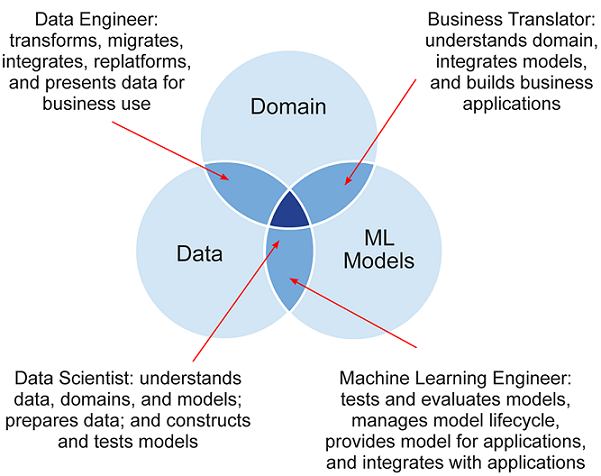
Use the team-role map to distinguish data-science work from the data, engineering, and business responsibilities surrounding it. section 3.2.2


How Delivering Machine Learning Projects: From design to deployment covers it

How deep it goes
Defines core responsibilities and team boundaries without detailing modelling techniques, testing procedures, or implementation steps.
What you can do after
Understand how data-science responsibilities fit alongside data engineering, ML engineering, and business translation.
How it connects
Links data scientists with data engineers, ML engineers, business translators, product owners, and domain alignment.

Also explained in

Compare how 4 books explain data scientist →

Related concepts

This explainer was generated by Manning's knowledge graph from the text of Delivering Machine Learning Projects: From design to deployment. The section links point to the parts of the book it draws on.

