A decision node represents a yes-or-no question in a decision tree. It has two branches: one for each possible answer. A node that cannot be split further becomes a leaf instead. section 9.0
Choosing whether to wear a jacket
A tree might first ask, “Is it raining?” If yes, it leads to a jacket decision. If no, another decision node can ask whether the temperature is hot or cold. A one-question tree is called a decision stump. section 9.0
During tree construction, a decision node follows this pattern:
- Select a feature that splits the node’s samples well according to the chosen metric. section 9.6
- Create two branches and attach the corresponding samples to new child nodes. section 9.6
- Keep the node as a decision node when splitting is allowed; otherwise assign the most common label and make it a leaf. section 9.4 section 9.6
Figure 9.2 A regular decision tree with a root node, decision nodes, branches, and leaves. Note that each decision node contains a yes-or-no question. From each possible answer, one branch emanates, which can lead to another decision node or a leaf. This tree has a depth of 2, because the longest path from a leaf to the root goes through two branches.
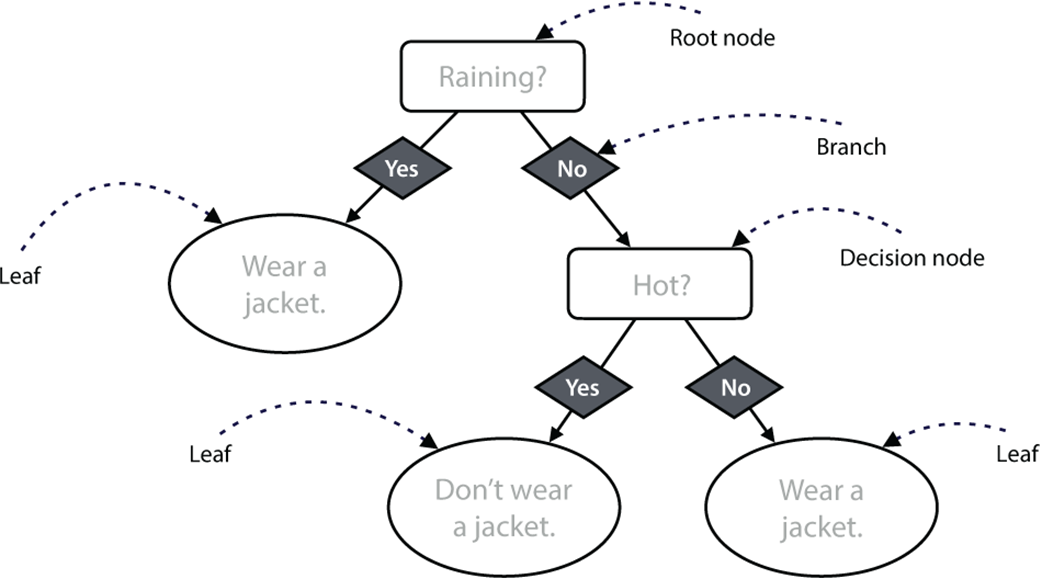
Use the diagram to see how questions, branches, decision nodes, and leaves form a binary decision tree. section 9.0




