A decision node marks a point in a decision tree where the decision-maker chooses among available actions. Usually drawn as a square, it sends each action along a separate branch. Unlike a chance node, it represents a choice the decision-maker controls; paths eventually reach terminal nodes that record outcomes as utilities, payoffs, or losses. section 7.1.2
The node makes the available acts explicit, but does not by itself identify the preferred act. Rollback combines probabilities and utilities from later branches to compare expected utility and select an act. section 7.1.2 section 7.6
Figure 7.1 Decision tree for the treatment decision. The square node represents the choice between treating and not treating. Each action leads to a circular chance node representing whether disease is present (𝑝 = 0.09) or absent (𝑝 = 0.91). The terminal branches show the four possible outcomes and their assigned utilities. Rolling the tree back combines the probabilities and utilities to produce expected utilities of −0.1 for treating and 91 for not treating, making the latter the preferred action.
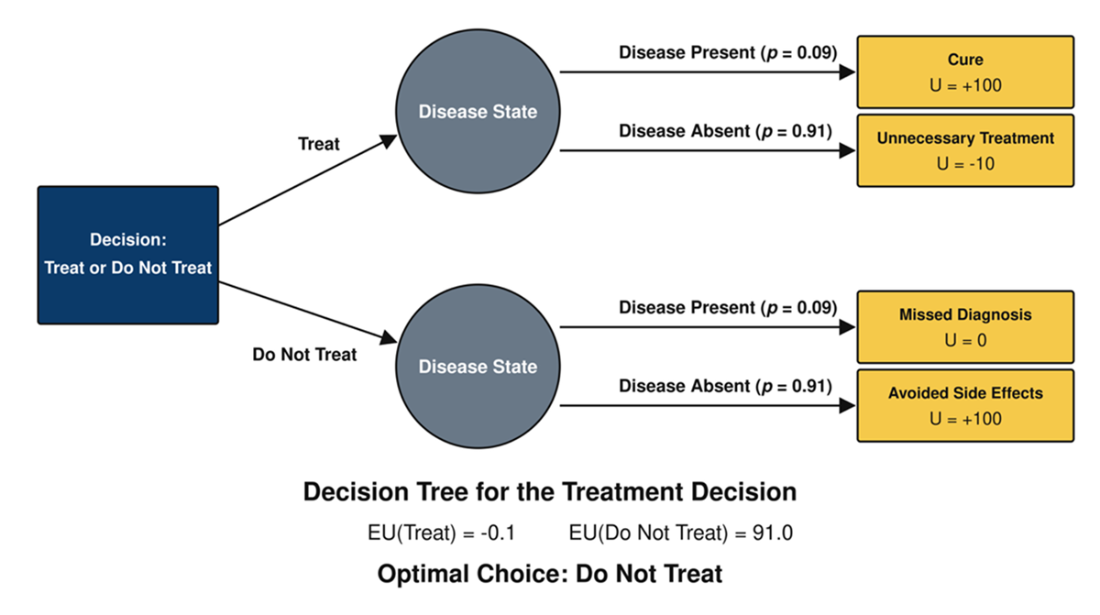
The treatment decision tree shows a square decision node branching to treating or not treating, with subsequent chance nodes and terminal utilities. section 7.1.2




