Defense in depth means protecting an organization with overlapping security controls rather than trusting one barrier. If a control fails, others can still prevent an incident, reveal it, or limit its impact. No single approach is foolproof. section 3.3 section 8.7.5
Think of a fortress with several lines of protection. Rules help people act safely; locks and guards restrict physical entry; firewalls filter network traffic; and controls closer to critical systems protect assets even if an outer layer is breached. section 3.3
Layers can combine different kinds of controls:
- Administrative: policies, procedures, training, and audits guide behavior and check that rules are followed. section 2.2.3 section 8.7.5
- Physical: locked rooms, cameras, guards, and increasingly restricted areas make unauthorized access harder to reach and easier to detect. section 8.7.5 section 9.2
- Technical: firewalls, multi-factor authentication, network segmentation, monitoring, and encryption protect systems and data at different points. section 3.3 section 8.7.5
Protecting a patient-records system
A critical patient-records system warrants more protection than an internal event calendar. An organization could combine access policies, locked rooms, multi-factor authentication, and network controls rather than expect any one measure to be enough. The choice of layers should reflect the asset’s value and the risk it faces. section 2.2.3 section 8.7.5
Layers need to work together, not simply accumulate. Controls cost money and can disrupt work; a cumbersome measure may even encourage people to bypass it. Choose controls for the risks they address, coordinate their implementation, and revisit them as risks and operating conditions change. section 2.2.3 section 3.0
Figure 3.2 Illustration of the defense-in-depth model
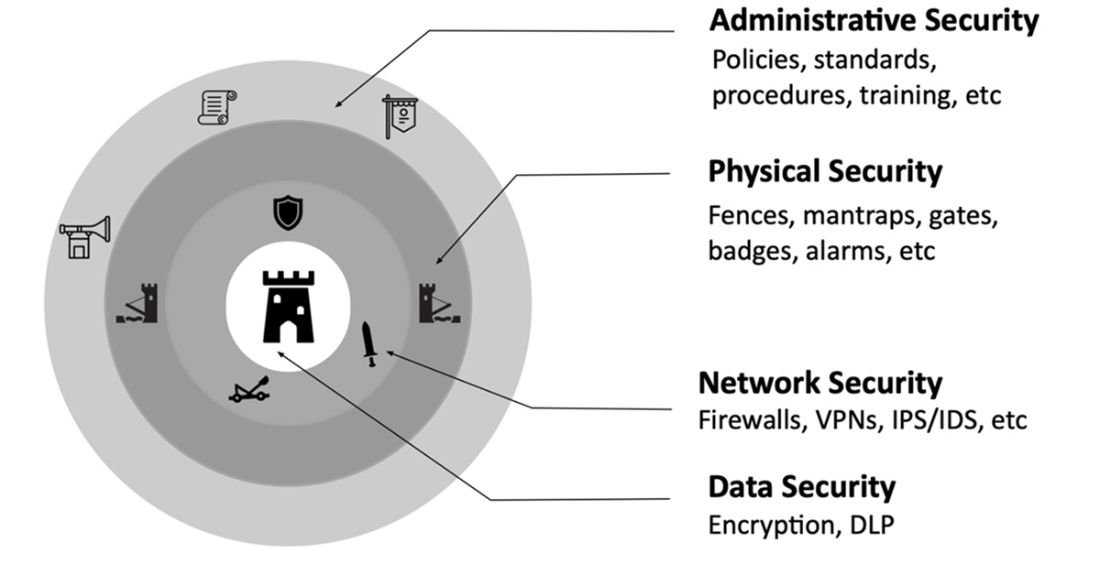
The concentric-layer diagram gives a visual guide to the fortress analogy, from organizational rules and physical barriers toward networks and core assets. section 3.3










