A device driver is the software layer that interfaces directly with hardware, manages device resources, and exposes a unified API to higher-level software. In robotics, drivers connect sensors and actuators to the rest of the software stack without requiring every application to manipulate registers or hardware protocols. section 2.1 section 2.2
A driver’s practical role includes:
- Reading device signals and converting hardware-level data into software-accessible values. section 2.1
- Sending software commands through electronics and converters to produce physical actuator behavior. section 2.1
- Hiding device-specific details behind reusable API layers, making robot applications easier to develop and maintain. section 2.1 section 2.2
Temperature sensor interface
A low-level implementation can read an ADC register, convert voltage to temperature, and return the result through get_temperature(). Higher-level code then uses the function without knowing register addresses, voltage conversion, or sensor bias. section 2.1
Figure 2.1 The inner structure of a generic sensor shows the chain of components that transform a physical property from the environment into data accessible via a software interface.
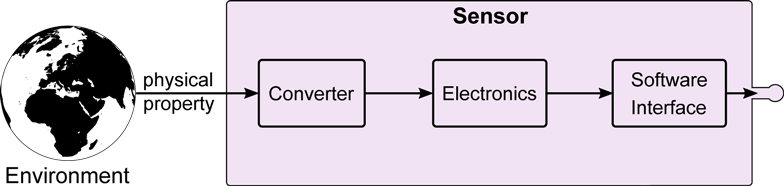
Trace how a physical sensor property becomes data available through a software interface. section 2.1

