Dilated, or atrous, convolution spreads a kernel across an image by inserting gaps between kernel values. A dilation rate of 2 skips one pixel, enlarging the field of view without adding parameters. section 6.2.2
This wider context is useful for image segmentation, where each pixel must be classified while preserving information from surrounding regions. DeepLabV3 uses dilated convolutions to segment forged and genuine receipt pixels. section 6.2 section 6.2.2
In receipt-forgery detection, dilated convolution supports:
- A broader image context without increasing convolutional parameter count. section 6.2.2
- Pixel-wise localization of small forged regions instead of only classifying an entire receipt. section 6.2
- Context-aware segmentation within DeepLabV3, alongside 1x1 convolution and atrous spatial pyramid pooling. section 6.5
Segmenting a forged receipt
Represent a receipt as a pixel-segmentation problem with forged and genuine classes. A DeepLabV3 model uses dilated convolutions to gather wider visual context while producing pixel-wise detections that reveal manipulated regions. section 6.2 section 6.5
Figure 6.8 Architecture of the DeepLabV3 segmentation model that uses atrous convolution, 1x1 convolution, and atrous spatial pyramidal pooling as some distinct features that help in accurate image segmentation. (source: https://learnopencv.com/deeplabv3-ultimate-guide/)
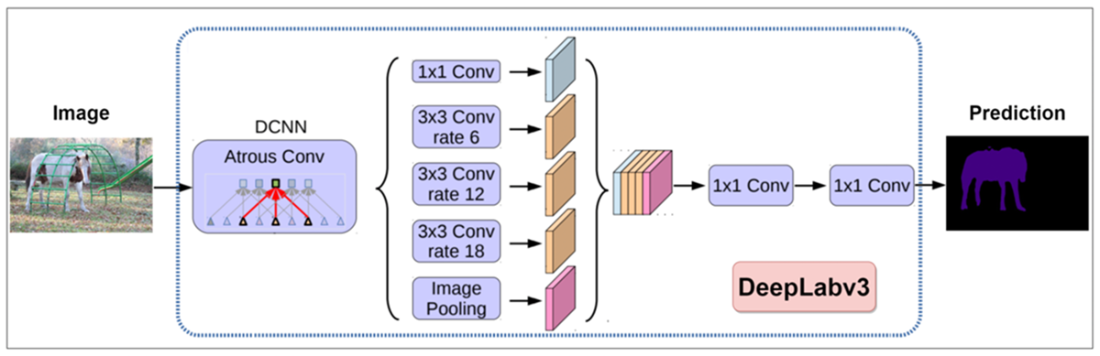
Inspect the DeepLabV3 architecture and its combination of atrous convolution, 1x1 convolution, and atrous spatial pyramid pooling. section 6.2

