A discrete variable takes values from a finite or countable set of distinct outcomes. A random variable X might represent a three-sided die roll with values {1, 2, 3}, or a coin flip with values {0, 1} or {True, False}. section 2.1.1
Each possible outcome receives a probability mass between zero and one, and the masses across all outcomes sum to one. Writing X = x identifies the event that X took the particular value x; this differs from continuous variables, which use probability densities over ranges. section 2.1.1 section 2.1.7
Common discrete distribution classes include:
- Categorical distributions assign probabilities to categories such as ice cream, frozen yogurt, and sherbet, or to indices representing those categories. section 2.1.7
- Bernoulli distributions are categorical distributions with two outcomes, while discrete uniform distributions assign equal probability to every outcome. section 2.1.7
Three-sided die
Represent a die roll as X ∈ {1, 2, 3}. The event X = 2 means that the observed roll was 2, and its probability is one entry in the variable's probability-mass specification. section 2.1.1
Figure 2.1 Three-sided dice each represent a random variable with three discrete outcomes.
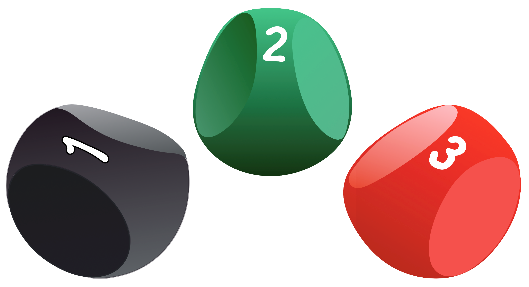
Use the die illustration to connect a physical random experiment with its finite set of discrete outcomes. section 2.1.1




