Storage capacity is the persistent disk space available for database data and related files. Cluster sizing must account for replication, uncompacted data, and future application growth. section 9.2.2
Estimate required cluster capacity with this practical baseline:
- Start with current or estimated data usage. section 9.2.2
- Multiply that amount by the replication factor. section 9.2.2
- Double the result to leave room for uncompacted data and application growth. section 9.2.2
- Distribute the resulting capacity across all nodes and choose disks fast enough for the workload; local SSDs are preferred for optimal throughput. section 9.2.2
A one-terabyte application
An application expected to store 1 TB with a replication factor of 3 needs 6 TB of disk space across the cluster: 1 TB × 3 × 2. section 9.2.2
Figure 9.5 Using smaller nodes in your cluster can be a cost-effective way to meet your throughput goals, as well as increase your cluster’s availability if you were to lose a quorum.
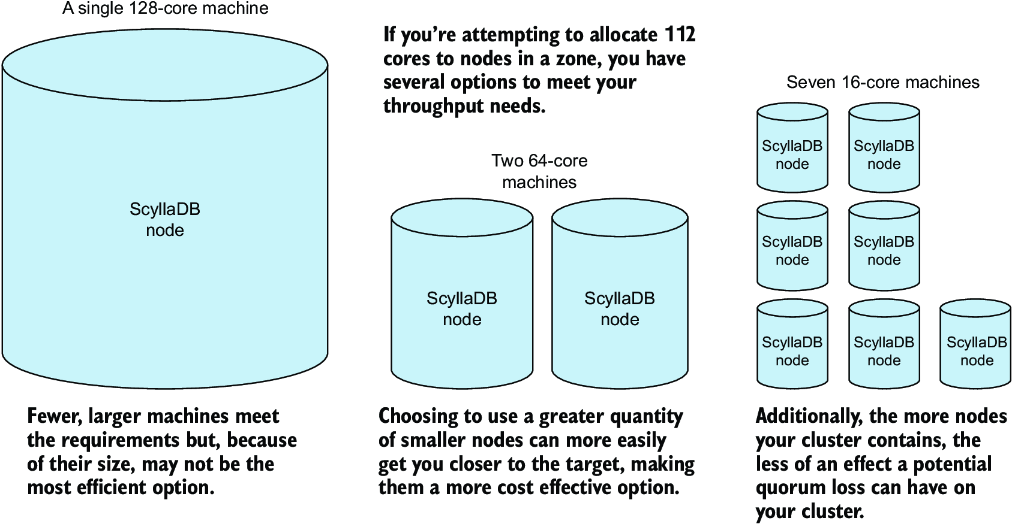
Compare cluster layouts that use smaller nodes to meet throughput goals and improve availability when a quorum is lost. section 9.2.2

