Distributed programming divides massive data-processing work into smaller tasks that run in parallel across a networked cluster, then combines the results. section 11.2.3
It becomes useful when traditional warehouses or local machines cannot efficiently query, retain, or analyze datasets containing billions or trillions of records. Each cluster node handles part of the work, reducing completion time and allowing processing to scale across computers. section 11.2.3
Key operational properties include:
- Parallelism divides a processing task into manageable chunks and recombines their outputs. section 11.2.3
- Fault tolerance reroutes a failed node’s assigned task to other nodes so the overall process can finish. section 11.2.3
- Distributed frameworks support large-scale data ingestion and processing when simple warehouse queries become slow or fail. section 11.2.3
Parallel processing
A massive dataset is split across cluster computers; each node processes its subset, and the system combines the subsets into a final result. section 11.2.3
Figure 11.10 Parallel processing divides a data processing task into manageable chunks and recombines it into the final output.
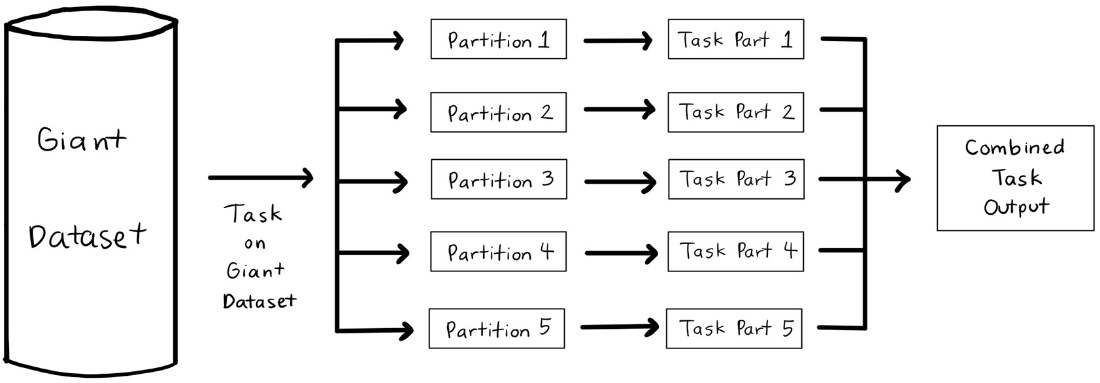
Shows how parallel processing divides a data task into chunks and recombines them into the final output. section 11.2.3


