A distributed system organizes capabilities across multiple coordinating components instead of concentrating them in one component. Distributed service architectures become valuable as platform complexity, networking demands, and organizational scale increase, but they require deliberate boundaries and coordination. section 2.3.5 section 9.0
Scaling does not require distributing every capability immediately. A sustainable design balances centralized strategies with distributed patterns, selecting boundaries and replication according to business priorities rather than applying one architecture everywhere. section 9.0
Platform teams use distributed-system principles to:
- Standardize distributed service compute and extensibility through a common control plane such as Kubernetes. section 2.3.5
- Coordinate independently operating teams with event-driven releases and contract tests that preserve reliability and trust. section 9.0
- Move non-differentiating infrastructure capabilities behind self-service APIs or capable cloud vendors, reducing maintenance opportunity costs. section 2.3.5
Scaling for regulated financial services
A financial-services organization may replicate its engineering platform in isolated environments to satisfy separation regulations before increasing general developer capacity. If external API access is the priority, it may first extend the control plane so developers can self-manage public API-gateway integrations. section 9.0
Figure 2.15 The components of a Kubernetes Cluster (Courtesy of https://kubernetes.io/docs/concepts/overview/components/)
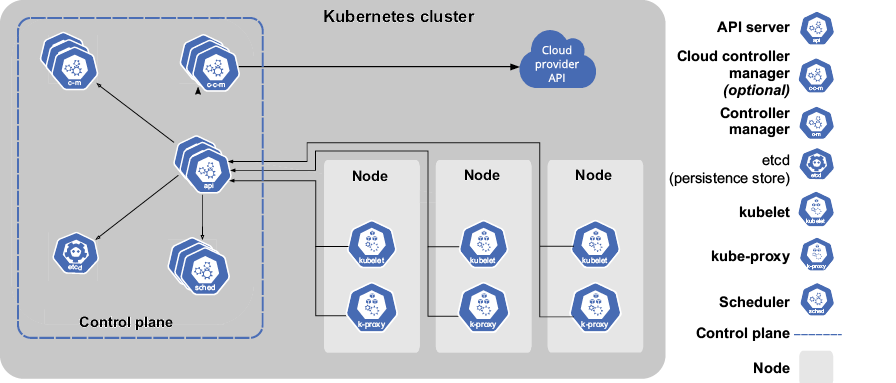
Use the cluster-components figure to inspect how a standardized control plane coordinates distributed service compute. section 2.3.5
Figure 9.1 Practical examples of evolutionary scaling strategies for engineering platform components
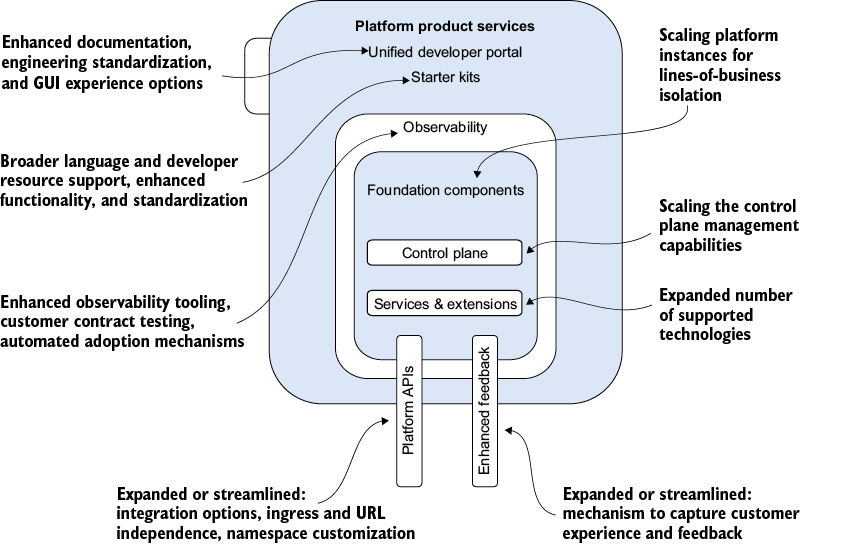
Use the scaling-strategies figure to compare evolutionary ways to distribute platform capabilities as demand and priorities change. section 9.0














